"It is #God who arms me with strength and makes my way perfect."~ Psalm 18:32- AMEN & SEMPER FIpinterest.com/pin/2030138956…
— Middleboro Jones (@Leadership_One) March 2, 2013
Showing posts with label Semper Fi. Show all posts
Showing posts with label Semper Fi. Show all posts
Saturday, March 2, 2013
Thought for the Day

Tuesday, December 4, 2012
Worcester, MA should be proud of USMC Sgt. William Soutra Jr., recipient of the NAVY CROSS
BRAVO ZULU and SEMPER FI Marine !! He has been awarded the Navy Cross for his efforts in Helmand Province, Afghanistan.
USMC Sgt. William Soutra Jr. works with SPEC OPS, which means he is not the kind of Marine who expects any recognition for what he does. In this instance, I am glad he was recognized and very proud of this son of Worcester, MA.
He is a true Patriot and one of our best.
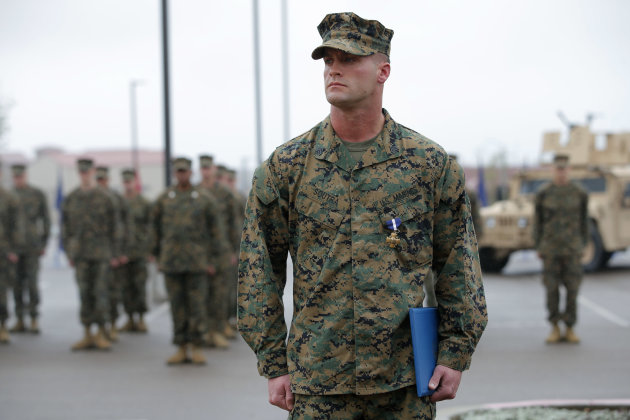
USMC Sgt. William Soutra Jr. works with SPEC OPS, which means he is not the kind of Marine who expects any recognition for what he does. In this instance, I am glad he was recognized and very proud of this son of Worcester, MA.
He is a true Patriot and one of our best.
Marine special operations team members honored
By | Associated Press – 1 hr 54 mins ago
Enlarge Photo
Associated Press/Jae C. Hong - U.S. Marine Sgt. William Soutra Jr. wears the Navy Cross during a ceremony held at Camp Pendleton, Calif., Monday, Dec. 3, 2012. Soutra Jr. was awarded the medal for his heroism
CAMP PENDLETON, Calif. (AP) — Navy Secretary Ray Mabus on Monday honored four members of a Marine special operations team in a rare public ceremony for those who have served in the covert forces.
In a ceremony at Camp Pendleton, Calif., Mabus awarded Marine Sgt. William Soutra Jr. the Navy Cross, the Navy's highest honor and the military's second highest honor, for tending to the wounded while guiding the platoon to safety during an attack in Afghanistan's Helmand Province in July 2010 that spanned over two days.
Three others on his team, including a Navy corpsman, were given Silver Stars.
Often the heroic actions of those on special operations teams are only known to each other and the leadership because of their covert work on classified missions.
"This is a chance to recognize people who don't get recognized much," Mabus said.
Soutra was a canine handler with a Marine special operations team when they were ambushed. After the team's assistant leader was fatally wounded by an enemy explosive during the ambush, Soutra jumped into action, repeatedly running into the line of fire as he helped direct troops to defend themselves and fight off the enemy, Mabus said.
At one point, the 27-year-old Marine from Worcester, Mass., placed a tourniquet on a wounded commando, before dragging him to a ditch for cover. He worked tirelessly for more than an hour after the initial blast and helped carry casualties through the sporadic gunfire, officials said.
His military dog stayed attached to his side during the ordeal. The dog had to be put down more than a year ago because it had cancer.
Maj. James Rose, Staff Sgt. Frankie Shinost Jr. and Navy Corpsman Patrick Quill were given Silver Stars for their actions that day.
The four men called it a horrible day because they lost their element leader, Staff Sgt. Chris Antonik.
"Every day I think about Chris," said Soutra, calling him a close friend and great warrior.
Soutra vowed to try to carry on as the kind of warrior that would make Antonik proud.
Friday, July 20, 2012
MARSOC MARINES HUNT TALIBAN ON MOTORCYCLES
 SEMPER FI - Go get'em Devil Dogs !!! - We need more Marines like these brave warriors who can take the fight to the bad guys on their own turf......awesome.
Motorcycle-borne MARSOC Marines prey on Taliban
July 18th, 2012 - Marine Times
This photo makes the Hell’s Angels look about as threatening as a litter of kittens.
Those are Marine special operators in Afghanistan, looking like something akin to a well-organized motorcycle gang. The photo is courtesy of former Staff Sgt. Michael Golembesky, who spent two years with Marine Corps Forces Special Operations Command, serving as a joint terminal attack controller.
As Marine Corps Times first reported back in March, MARSOC teams use these small-engine bikes to get around in the Afghan mountains. Before some units deploy, the command sends them through a super-sensitive training program that provides five days of schooling on off-road riding and general motorcycle maintenance.
Golembesky published his photos on SofRep.com, a site that tracks U.S. and British special operations news. An accompanying narrative describes how Marine special operations teams have been using dirt bikes and ATVs to track down Taliban fighters in the dead of night. The small vehicles allow them to swiftly maneuver in areas where larger vehicles can’t, and the noise they make keeps the enemy guessing by blending in with the sound of local traffic, Golembesky writes. Is it another villager — or one of the world’s most elite warriors swooping in for a kill? In some cases, where foreign bikes and ATVs are difficult to keep running, MARSOC Marines have used the same small motorcycles that Taliban fighters ride to make quick escapes after planting IEDs or taking potshots at U.S. patrols.
Golemesky is writing a book about MARSOC. Titled Level Zero Heroes, the account will examine his experiences in Bala Morghab, Afghanistan, during 2009 and 2010. It is set for release in 2013.
Friday, July 6, 2012
Marine Sergeant Enrique Trevino will do 1 Million Push-ups to help the Wounded Warriors Project
 SEMPER FI Sgt. Trevino. An awesome effort for a good cause.
Marine Doing 1 Million Push-Ups to Help Veterans
South Florida Marine is halfway toward his goal
By Justin Finch -Thursday, Jul 5, 2012 - www.nbcmiami.com
South Florida Marine Sergeant Enrique Trevino is more than halfway to his goal of completing one million push-ups to raise money and awareness for American veterans.
"In the very beginning, there were a lot of people who said your body can't handle it," Trevino told NBC 6. "That's their first mistake was telling a Marine you can't do something."
Trevino began his one million push-up pursuit as a New Year's fitness resolution, but soon realized he could turn it into an opportunity to help the Wounded Warriors Project. The organization helps veterans of the wars in Afghanistan and Iraq, where Trevino himself has served, get reacquainted into post-military life.
He said not all vets return with wounds that one can easily see.
"People who are suffering from PTSD. Those are scars that are not seen, but people don't notice everyday," Trevino pointed out. "I'm just trying to bring awareness to those veterans who're transitioning into civilian life, and just make sure they're never forgotten."
Thanks to his push-ups and presence on Facebook and Youtube, Trevino has earned more than $9,000 for his cause. Still, his sights are set much higher.
"My goal is to reach $20,000, but if we can do more than that, which I know we can, I'm all for it," he said.
Last week, Trevino cracked the 500,000 mark, but he said that has not made his push up routine any easier.
"I'd be lying if I said it got easier, but my endurance has gotten better."
Monday, June 18, 2012
SEMPER FI CODY GREEN
Many will never understand it fully but this is why our USMC are the very best. They made a small boy part of their esteemed history by granting his wish to become a US Marine before he died.
SEMPER FI and Bravo Zulu to all those who helped this boy achieve his dream. All our prayers for Cody and his family.
Rest Easy Cody, your Marine Brothers and Sisters have the watch.
 A United States Marine stands watch over the hospital door of 12-year-old Cody Green in Florida, Ind. After successfully battling leukemia since he was 22 months old, Green died after a fungus attacked his brain. (Courtesy WLFI/Riley Children's Hospital)
Boy made honorary Marine before he dies
6/13/2012
Meera Pal, WTOP.COM
WASHINGTON - Before he died, 12-year-old Cody Green achieved his dream of becoming a United States Marine.
Green had always admired the strength and courage of the Marines says his father, David Snowberger.
Snowberger tells an Indiana-based television station the Marines decided Green had showed "strength and honor and courage" through his health battles.
SEMPER FI and Bravo Zulu to all those who helped this boy achieve his dream. All our prayers for Cody and his family.
Rest Easy Cody, your Marine Brothers and Sisters have the watch.

Boy made honorary Marine before he dies
6/13/2012
Meera Pal, WTOP.COM
WASHINGTON - Before he died, 12-year-old Cody Green achieved his dream of becoming a United States Marine.
Green had always admired the strength and courage of the Marines says his father, David Snowberger.
Snowberger tells an Indiana-based television station the Marines decided Green had showed "strength and honor and courage" through his health battles.
Monday, April 30, 2012
SEMPER FI...All gave some, some gave all
We support for our military and their families when they need it most

Wednesday, March 21, 2012
44% of the USMC NCOs view the President as a failure - Marine Corps Times
 An interesting cover story in the MARINE CORPS TIMES.....Very Interesting based on how things are going politically....Obama is lining up the military for major cuts and that is NOT sitting well with the troops.
Here is a clip of what the article says:
Sgt. Gary Stein might be saying things about President Obama that a lot of Marines think, but some are saying he took it too far.
Stein has come under fire for stating on Facebook that he wouldn’t follow certain orders given by his commander in chief. And Marines say Stein’s not alone in his disapproval. More anti-Obama talk is being heard in the workplace and new Military Times poll data shows declining approval among military service members for the president’s job as commander in chief.
The Marine Corps depends its chain of command structure, especially in a time of war. Some Marines say Stein and other vocal Marines like him are undermining that system.
Two Commenters responded to the article in unique fashion -
One posted this -
" That whenever any Form of Government becomes destructive of these ends, it is the Right of the People to alter or to abolish it, and to institute new Government, laying its foundation on such principles and organizing its powers in such form, as to them shall seem most likely to effect their Safety and Happiness. Prudence, indeed, will dictate that Governments long established should not be changed for light and transient causes; and accordingly all experience hath shewn, that mankind are more disposed to suffer, while evils are sufferable, than to right themselves by abolishing the forms to which they are accustomed. But when a long train of abuses and usurpations, pursuing invariably the same Object evinces a design to reduce them under absolute Despotism, it is their right, it is their duty, to throw off such Government, and to provide new Guards for their future security.” - Declaration of independence
Many feel that things have gotten worse for personal liberties under Obama, and that drives this sentiment...I understand and see the point this reader makes especially when the troops and the USMC pays for our liberty by sacrificing their lives.
The 2nd one posted this -
UCMJ Article 88: “Any commissioned officer who uses contemptuous words against the President, the Vice President, Congress, the Secretary of Defense, the Secretary of a military department, the Secretary of Transportation, or the Governor or legislature of any State, Territory, Commonwealth, or possession in which he is on duty or present shall be punished as a court-martial may direct.”
Funny but the article focuses on NCOs not commissioned officers....still having public dissent with the chain of command is problematic.
I understand and agree with the 44% of the USMC NCOs as the President is a failure and a disgrace. He & his wife spent their adult lives dumping on the military and now "act" supportive. Obama has spent billions on the stimulus fiasco which will now mean drastic cuts in the defense department.
You ask why Marines are upset ? Colonel Jessup stated it eloquently in " A Few Good Men ":
" You don't want the truth because deep down in places you don't talk about at parties you want me on that wall, you need me on that wall. We use words like honor, code, loyalty. We use them as the backbone of a life trying to defend something. You use them as a punchline.
I have neither the time nor the inclination to explain myself to a man who rises and sleeps under the blanket of the very freedom I provide and then questions the manner in which I provide it. I would rather you just said "thank you," and went on your way. Otherwise, I suggest that you pick up a weapon and stand a post. Either way, I don't give a damn what you think you are entitled to.."
Obama asks the military to go through hell for the country and then guts it with the budget pen when it suits him politically. The military vote has been historically supportive of the GOP and based on the President's failures to do the job, Marines are not happy. They strive for excellence and the President is the king of mediocrity.
I'll stand with the USMC as I served side by side with them in Iraq and other difficult places.....As a Seabee, I saw the USMC at their best. The idiot in the Oval Office is a fraud, failure and it shows.
I have neither the time nor the inclination to explain myself to a man who rises and sleeps under the blanket of the very freedom I provide and then questions the manner in which I provide it. I would rather you just said "thank you," and went on your way. Otherwise, I suggest that you pick up a weapon and stand a post. Either way, I don't give a damn what you think you are entitled to.."
Obama asks the military to go through hell for the country and then guts it with the budget pen when it suits him politically. The military vote has been historically supportive of the GOP and based on the President's failures to do the job, Marines are not happy. They strive for excellence and the President is the king of mediocrity.
I'll stand with the USMC as I served side by side with them in Iraq and other difficult places.....As a Seabee, I saw the USMC at their best. The idiot in the Oval Office is a fraud, failure and it shows.
As for the USMC, they are respected by all who know them.....As someone once said, No Better Friend, No worse enemy.
SEMPER FI.
Saturday, March 10, 2012
SEMPER FIDO - Marine Seeks to Adopt Military Dog
 SEMPER FIDO....Let's hope these two Marines get reunited soon.
Marine Seeks to Adopt Military Dog
Saturday, 10 Mar 2012
MYFOXNY.COM -
A former Marine is hitting bureaucratic red tape in her quest to adopt the military service dog she served with in Iraq before it is put down.
Former Corporal Megan Leavey, of Rockland County, wants to take in a German shepherd named Sergeant Rex. They hunted for IEDs on Iraq during two tours of duty.
They were both severely injured in Iraq when an IED exploded near them. The dog is 10 years old now and can no longer serve.
"This is not (the Marines) first priority," Leavey admits, "A lot of times it gets lost in the shuffle."
But time is running out for the faithful dog.
"He's done his duty. It's time for him to relax," Leavey says.
Sen. Charles Schumer has stepped in and has asked the military to expedite Leavey's application to adopt Sergeant Rex before he is put to sleep.
"The Marines don't have a reason against reuniting them, it is mainly a paperwork dely."
Sunday, December 11, 2011
Make peace or die....Take a walk with the 1/5 Marines in Sangin
The 3/5 Marines had a tough fight in Sangin from September 2010 - May 2011. The 1/5 Marines relieved them and built upon the success of their shipmates through this summer and into the fall.
Watch the enclosed video (yes, I understand it is 17 minutes long...Watch the video and give them the time they have earned) is a view of what your US Marines have been doing out in the Shitewilds of Afghanistan. This is a small peak into how tough it can really be out there at the "tip of the spear".
Watch the enclosed video (yes, I understand it is 17 minutes long...Watch the video and give them the time they have earned) is a view of what your US Marines have been doing out in the Shitewilds of Afghanistan. This is a small peak into how tough it can really be out there at the "tip of the spear".
I have been to Helmand and spent time with our USMC. They are doing the impossible in a harsh landscape and should make each American proud. Agree or disagree with the mission, this is the truest example of what we stand for and why we are Americans. Semper FI 1/5 Marines.
Saturday, November 26, 2011
USMC to leave Helmand in 2012 - A case of what is needed or is this being done for political gains ?
 The Commandant of the Marines was out in Helmand Province to see the troops and to spend Thanksgiving Day with them, but he was also there to let them know that this mission is not going to continue for long. It appears the USMC has been given new marching orders and they are preparing to depart Afghanistan much sooner than previously planned.
This is likely based on fiscal and political issues, not what is needed on the ground. While it is true that Afghanistan needs to stand up for itself, and man it's own defense, the nature of the fight there shows that if we leave too soon, the country will fall back into chaos. The efforts we have provided over 10 years could all be for naught.
I am glad the Marines will be leaving but is it the right move or are they being pressured to fulfill the President's political goals?? There have been too many times over the last three years where Obama's personal political goals have been placed ahead of what is right and I hope that this is not one of those cases.
Semper Fi to the USMC and the troops in Helmand. I was there and have a greater understanding what you are dealing with on a daily basis than the POLS in Washington DC.
Marines to wind down Afghan combat in 2012
By ROBERT BURNS AP –
CAMP LEATHERNECK, Afghanistan (AP) — U.S. Marines will march out of Afghanistan by the thousands next year, winding down combat in the Taliban heartland and testing the U.S. view that Afghan forces are capable of leading the fight against a battered but not yet beaten insurgency in the country's southwestern reaches, senior U.S. military officers say.
At the same time, U.S. reinforcements will be sent to eastern Afghanistan in a bid to reverse recent gains by insurgents targeting Kabul, the capital.
Gen. James F. Amos, commandant of the Marine Corps, said in an Associated Press interview that the number of Marines in Helmand province will drop "markedly" in 2012, and the role of those who stay will shift from countering the insurgency to training and advising the Afghan security forces.
The change suggests an early exit from Afghanistan for the Marine Corps, even as the prospects for solidifying their recent successes are uncertain.
"Am I OK with that? The answer is 'yes,'" Amos said. "We can't stay in Afghanistan forever."
He added: "Will it work? I don't know."
At stake is President Barack Obama's pledge to win in Afghanistan — the war he touted during his 2008 presidential campaign as worth fighting, while pledging to get out of Iraq. Facing a stalemate in 2009, Obama ordered an extra 30,000 U.S. troops to Afghanistan — including about 10,000 Marines to Helmand province — on the belief that if the Taliban were to retake the government al-Qaida would soon return to the land from which it plotted the 9/11 attacks.
Also at stake are the sacrifices of the nearly 300 Marines killed in Afghanistan over the past three years.
Weighing against prolonging the conflict is its unsustainable cost and what author and former Defense Department official Bing West has called its "grinding inconclusiveness."
In a series of pep talks to Marines in Helmand this past week, Amos said the Marine mission in Afghanistan would end in the next 12 to 18 months. That is as much as two years before the December 2014 deadline, announced a year ago, for all U.S. and other foreign troops to leave the country.
"Savor being out here together," Amos told Marines on Thanksgiving at an outpost along the Helmand River called Fiddler's Green, "because it's going to be over" soon.
He was referring only to the Marines' role, which is limited mainly to Helmand, although there also are Marine special operations forces in western Afghanistan. The U.S. military efforts in Kandahar province and throughout the volatile eastern region are led by the Army, along with allied forces.
Helmand and neighboring Kandahar for the past two years have been the main focus of the U.S.-led effort to turn the tide against a resilient Taliban insurgency. In that period, the Taliban and other insurgent networks have grown bolder and more violent in Afghanistan's eastern provinces where they have the advantage of sanctuary across the border in Pakistan and where U.S. and NATO forces are spread more thinly than in the south.
During two days of visiting Marine outposts throughout Helmand this week, Amos touted progress against the Taliban and was told by Marine commanders that plans are well under way to close U.S. bases, ship war equipment home and prepare for a major drawdown of Marines beginning next summer. Amos declined to discuss the number of Marines expected to leave in 2012, but indications are that 10,000 or more may depart.
There are now about 19,400 Marines in Helmand, and that is due to fall to about 18,500 by the end of this year.
Marine Gen. John Allen, the top overall commander of U.S. and NATO forces in Afghanistan, was ordered by Obama last summer to pull out 10,000 U.S. forces by the end of this year and another 23,000 by the end of September 2012. That has driven the move to accelerate a transition to Afghan control.
Allen said in an interview Thursday that winding down the Marine combat mission in Helmand makes sense because security "has gotten so much better now." He said the pullout of 23,000 U.S. forces in 2012, including an unspecified number of Marines, likely will begin in the summer, which historically is the height of the fighting season in Afghanistan. Allen said Afghan security forces, often criticized for weak battlefield performance, desertion and a lack of will, are closer to being ready to assume lead responsibility for their nation's defense than many people believe.
"The Afghan national security forces are better than they thought they were, and they're better than we thought they were," Allen said.
That is why he thinks it's safe to lessen the Marine's combat role in Helmand, reduce their numbers and put the Afghans in charge.
That approach also allows Allen to build up elsewhere. He said that in 2012 he will put more U.S. forces in eastern Afghanistan, increase the number of U.S. special operations forces who are playing a key role in developing Afghan forces, and add intelligence, surveillance and reconnaissance resources. He said he plans to add "several battalions" of U.S. forces in the east. He gave no specific troop number, but a battalion usually totals about 750.
"I'm going to put a lot more forces and capabilities into the east," he said. "The east is going to need some additional forces because our intent is to expand the security zone around Kabul."
The top Marine in Helmand, Maj. Gen. John Toolan, said he is not convinced that 2012 is the best time to shift the focus to eastern Afghanistan, where the Haqqani network has taken credit for a series of spectacular attacks recently, including suicide bombings inside Kabul, the heavily secured capital. He said he believes the Taliban movement in southern Afghanistan is still the biggest threat to the viability of the central government.
Toolan said the Marines continue to make important progress against a Taliban whose leaders are showing signs of frustration and division.
"They're starting to break up," Toolan said. "There's still a lot to be done to see that these insurgents stay on their backs."
Stephen Biddle, a defense analyst at the Council on Foreign Relations and who recently visited U.S. forces in Afghanistan, said there is a risk to putting the Afghans in the lead role in Helmand as early as 2012.
"If you throw them into the deep end and put them in the lead in really tough neighborhoods you run the risk that they get their noses bloodied early in ways that could make it hard for them to recover because they lose confidence," Biddle said in an interview in Washington. On the other hand, if the U.S. and its allies wait until 2013 or 2014 to hand off to the Afghans in the most challenging areas, there would be less chance to bail them out.
"It's a dilemma with no obvious solution to it," he said
Tuesday, November 22, 2011
A year ago today....and then some


What were you doing a year ago today ? It was a Monday so many were going to work, taking care of the kids, running errands in preparation for Thanksgiving Day, etc.
But if I asked you specifically what you were doing a year ago today, would you be able to tell me ? Probably not as the days meld into each other as time passes and we lose memory of specific actions on a date as far back as a year ago.
I can tell you as it is a day that held much importance to me and many others.
A year ago today on November 22, 2010, I traveled to Washington, DC for the funeral of Lt. Robert M. Kelly, USMC. He had died in Afghanistan and was part of the contingent of Marines who had kept me safe while I spent time out in Helmand Province. Unknown to me at the time, was that he was also part of the Marine Battalion that I had served under while I was in Fallujah also. We were shipmates and had likely crossed paths while in Fallujah. I went to his funeral after learning of this splendid Marine's death and that he was in Afghanistan in Sangin. I had the honor of speaking with many Marines who were working in that area and they are our nation's best.
Back to the original point, a year ago I was in Washington, DC. 48 years ago, I was a small child at home when the news broke that we had lost President Kennedy in Dallas. I can't tell you much about that day other than my Mom wouldn't stop crying, and to a young lad like myself, that was odd. The memory of that day was being a small boy with a very sad Mom. The loss we suffered that day was great. History would be very, very different if not for the loss of President Kennedy.
Time passes and the world moves on. A thought not lost on me today as we think about those lost to war and to a sniper's bullets 48 years ago today.
Enclosed is the post I made a year ago regarding Lt. Robert M. Kelly, USMC and the services for him at Arlington National Cemetery. He was a good man and a fine Marine, serving our country. We remember him and all others who gave the ultimate sacrifice in defense of our nation.
But if I asked you specifically what you were doing a year ago today, would you be able to tell me ? Probably not as the days meld into each other as time passes and we lose memory of specific actions on a date as far back as a year ago.
I can tell you as it is a day that held much importance to me and many others.
A year ago today on November 22, 2010, I traveled to Washington, DC for the funeral of Lt. Robert M. Kelly, USMC. He had died in Afghanistan and was part of the contingent of Marines who had kept me safe while I spent time out in Helmand Province. Unknown to me at the time, was that he was also part of the Marine Battalion that I had served under while I was in Fallujah also. We were shipmates and had likely crossed paths while in Fallujah. I went to his funeral after learning of this splendid Marine's death and that he was in Afghanistan in Sangin. I had the honor of speaking with many Marines who were working in that area and they are our nation's best.
Back to the original point, a year ago I was in Washington, DC. 48 years ago, I was a small child at home when the news broke that we had lost President Kennedy in Dallas. I can't tell you much about that day other than my Mom wouldn't stop crying, and to a young lad like myself, that was odd. The memory of that day was being a small boy with a very sad Mom. The loss we suffered that day was great. History would be very, very different if not for the loss of President Kennedy.
Time passes and the world moves on. A thought not lost on me today as we think about those lost to war and to a sniper's bullets 48 years ago today.
Enclosed is the post I made a year ago regarding Lt. Robert M. Kelly, USMC and the services for him at Arlington National Cemetery. He was a good man and a fine Marine, serving our country. We remember him and all others who gave the ultimate sacrifice in defense of our nation.
Semper Fi Lt. Kelly, we have the watch.
US Navy Jeep - 11/22/10
ALCON -
As I have witnessed, many of the readers of this blog hold the mission that our military undertakes as serious business. There can be no more serious business than putting men & women in the uniform of our country in harm's way. I deeply appreciate the support that each of us give to this mission.
Today, I was able to fulfill part of that mission by attending the funeral services for Lt. Robert M. Kelly, USMC today at the Fort Myer Chapel, located next to Arlington National Cemetery in Washington, DC. I was able to do so because I work for an Airline since arriving back in Boston from Afghanistan, and they are the kind of company that not only allows you to get on a jet anytime you want to (or need to) but also encourages you to do so. I was encouraged to do this by my colleagues and it was approved by my supervisor. I thought about it and decided in a very short time, that it was the absolutely right thing to do, I can do it, and I should do it.
Monday Morning, Nov. 22nd, I got on a flight out of Boston and arrived at Reagan National Airport in just over an hour. Arlington National Cemetery is very close (2 1/2 miles) and I got a cab there. Of Course, the cabby didn't know about the location for the ceremony and he was able to bring me deep into the middle of Arlington National Cemetery. I got turned around for a minute and wound up back near the entrance. It gave me the opportunity to pay my respects to President Kennedy, Jacqueline Kennedy and their children who are buried there. The fact that this was November 22nd was not lost on me and seemed ironic that I would be travelling there to honor a Marine and still it happens to be November 22nd of all days. I also paid my respects at his brother's gravesites Senator Robert Kennedy and Senator Edward Kennedy. Each are buried close together near the front of the park.
Afterwards I had to find my way to the other side of the cemetery and was helped out by a park employee. I wound up on a brisk walk across Arlington National Cemetery, and emerged at the back gate which leads into Ft. Meyer. The Gate Guards pointed the way and the chapel was only 1000 yards across the base. I arrived slightly warm but no worse for the wear.
I was in line with hundreds of others, and spent part of my time speaking to young Marine Sgt. who was with friends who are also Marines, but were in civilian dress. The line was a who's-who of military with enough Two Star & Three Star Generals, Navy Captains, Marine Colonels and so many other officers that you could have filled an antique shop with all the brass. Many others there also including Policemen, Firemen and people from various groups to pay their respects. We were ushered in to the Chapel and directed to our seats by Marines as attendants. The Chapel is a bright and airy space, modern but at the same time, providing you with a sense of history.
The ceremony began with a presentation to Lt. Kelly's wife and family of the commendations awarded to him. A Purple Heart for wounds sustained in the battle he died in and a Navy/Marine Corps Commendation medal with Combat Distinguishing Device.authorized for valor (heroism) for a number of missions he accomplished including the one where he lost his life.
The services were very appropriate and the Navy Chaplain gave a great sermon about the meaning of how Christ died for us and he conquered death so that we would not need to be afraid. That Robert had simply gone on to eternal life with our Lord Jesus Christ and was waiting for friends & family when they got there. He ended his sermon with a traditional Irish Blessing (given in Gaelic) saying, " Farewell, God Bless you and see you when we meet again. "
The eulogies were given by his Brother, Capt. John Kelly, USMC and his father Lt. General John F. Kelly, USMC. His Brother went first and spoke about how his brother was a fine man, happy and as expected, the light of his families' life along with his bride, Heather. It was in the middle of his Brother's eulogy that I realized why I was drawn to be there on this day for this Marine.
Captain Kelly detailed about his Brother's career and spoke about the different assignments that Robert had held including Operation Iraqi Freedom, and specifically Operation Al Fajr in Fallujah in November 2004. It was at that moment that the Good Lord's desire to have me go became apparent to me. I was struck by the fact that not only had I been in Afghanistan with this splendid young Marine, but we had served together in Fallujah when I was there in 2004-2005. He & I were not personally acquainted, but we had served under the same Marine Command, and he was there providing security for me & my fellow Seabees. I found myself welling up and thanking the Lord for his will to push me to be there to honor this Marine as Robert was one of those who helped me while I was deployed.
His brother spoke about that the streets of our country and other countries around the world were guarded by United States Marines. He said that he was confident that the streets in Heaven were also guarded by United States Marines. He then stated, " And my Brother is one of those Marines, guarding the streets in heaven." Very touching and true, I am sure.
His father spoke next, saying first and foremost, that he was not there to eulogize his son. He stated "Anyone who is laid out for his final resting place dressed in the uniform of his country's finest, the United States Marines, and wrapped in his country's flag did not need eulogizing and his life's accomplishments are evident to all." Lt. General Kelly went on to describe that we as a country are at war with an enemy that will not go away and only wants our destruction and submission. He spoke eloquently regarding his opinion of the threat our nation faces and how that we as a country are protected by a small number of men & women who volunteer, give up their regular lives and go out to defend our nation against those who would do it harm. He said that many doubt our country but he said as long as our country produced men & women like those he spoke of, there was much hope that we would rid the world of the vile filth that wages terror against innocents.
His last statement was poignant as he described how as a Commander, he had to speak to many families and wounded Marines about the loss of their friends, sons, brothers, fathers and others. Each time, whether he wrote them a letter from overseas, or visited with them in person, he tried to imagine what they were going through and empathize with their loss.
He then stated, " I owe each and every one of them an apology as I could not imagine the depth of the pain they were going through as my wife and I have been going through it since we were notified of the loss of our son. It is unbearable. " His statement speaks volumes to a Father's love & pride for his son.
I was honored and privileged enough to be in attendance among many of our country's finest warriors, Robert's friends & family and felt that I had been called there by a force much greater than anything I can explain here with my paltry words. It was a moment I will not forget.
I had to leave at the end of the ceremonies as I had to catch the return flight to Boston and the services ended close to 2:10 with my return flight at just after 3:00. I was able to walk back across Arlington National Cemetery to the main entrance where they have cabs standing by. I imagined that somewhere in heaven, there was a Marine Lt. laughing as he watched this old Seabee hump his way back across the cemetery to the cab stand. I hope it provided all of them up there in heaven a good laugh. I regret that I was unable to attend the graveside ceremonies, but being there for his services was extraordinary. The time schedule only allowed me time to be there for the service in the chapel.
I caught a cab to the airport, checked in for the flight and was able to be back in my office in Boston by 17:00, no worse for the wear & tear but feeling that I had fulfilled and important mission Monday. Honoring one of our Country's finest, a warrior, son, brother, friend, husband and defender of our Flag.
There could be no finer mission than the one he fulfilled and I wanted to make sure I did not fail in my mission to honor him as we had shared many of the same places and experiences. He as a United States Marine and me, as a US Navy Seabee in Iraq and a contractor supporting the Marines at Camp Leatherneck, Afghanistan. He & I share a bond that was not apparent until his passing but carried no less importance after his death than it did in life. We were brothers-in-arms and that was all that mattered.
Fair Winds & following seas, shipmate. Rest easy Marine, we have the watch.
As I have witnessed, many of the readers of this blog hold the mission that our military undertakes as serious business. There can be no more serious business than putting men & women in the uniform of our country in harm's way. I deeply appreciate the support that each of us give to this mission.
Today, I was able to fulfill part of that mission by attending the funeral services for Lt. Robert M. Kelly, USMC today at the Fort Myer Chapel, located next to Arlington National Cemetery in Washington, DC. I was able to do so because I work for an Airline since arriving back in Boston from Afghanistan, and they are the kind of company that not only allows you to get on a jet anytime you want to (or need to) but also encourages you to do so. I was encouraged to do this by my colleagues and it was approved by my supervisor. I thought about it and decided in a very short time, that it was the absolutely right thing to do, I can do it, and I should do it.
Monday Morning, Nov. 22nd, I got on a flight out of Boston and arrived at Reagan National Airport in just over an hour. Arlington National Cemetery is very close (2 1/2 miles) and I got a cab there. Of Course, the cabby didn't know about the location for the ceremony and he was able to bring me deep into the middle of Arlington National Cemetery. I got turned around for a minute and wound up back near the entrance. It gave me the opportunity to pay my respects to President Kennedy, Jacqueline Kennedy and their children who are buried there. The fact that this was November 22nd was not lost on me and seemed ironic that I would be travelling there to honor a Marine and still it happens to be November 22nd of all days. I also paid my respects at his brother's gravesites Senator Robert Kennedy and Senator Edward Kennedy. Each are buried close together near the front of the park.
Afterwards I had to find my way to the other side of the cemetery and was helped out by a park employee. I wound up on a brisk walk across Arlington National Cemetery, and emerged at the back gate which leads into Ft. Meyer. The Gate Guards pointed the way and the chapel was only 1000 yards across the base. I arrived slightly warm but no worse for the wear.
I was in line with hundreds of others, and spent part of my time speaking to young Marine Sgt. who was with friends who are also Marines, but were in civilian dress. The line was a who's-who of military with enough Two Star & Three Star Generals, Navy Captains, Marine Colonels and so many other officers that you could have filled an antique shop with all the brass. Many others there also including Policemen, Firemen and people from various groups to pay their respects. We were ushered in to the Chapel and directed to our seats by Marines as attendants. The Chapel is a bright and airy space, modern but at the same time, providing you with a sense of history.
The ceremony began with a presentation to Lt. Kelly's wife and family of the commendations awarded to him. A Purple Heart for wounds sustained in the battle he died in and a Navy/Marine Corps Commendation medal with Combat Distinguishing Device.authorized for valor (heroism) for a number of missions he accomplished including the one where he lost his life.
The services were very appropriate and the Navy Chaplain gave a great sermon about the meaning of how Christ died for us and he conquered death so that we would not need to be afraid. That Robert had simply gone on to eternal life with our Lord Jesus Christ and was waiting for friends & family when they got there. He ended his sermon with a traditional Irish Blessing (given in Gaelic) saying, " Farewell, God Bless you and see you when we meet again. "
The eulogies were given by his Brother, Capt. John Kelly, USMC and his father Lt. General John F. Kelly, USMC. His Brother went first and spoke about how his brother was a fine man, happy and as expected, the light of his families' life along with his bride, Heather. It was in the middle of his Brother's eulogy that I realized why I was drawn to be there on this day for this Marine.
Captain Kelly detailed about his Brother's career and spoke about the different assignments that Robert had held including Operation Iraqi Freedom, and specifically Operation Al Fajr in Fallujah in November 2004. It was at that moment that the Good Lord's desire to have me go became apparent to me. I was struck by the fact that not only had I been in Afghanistan with this splendid young Marine, but we had served together in Fallujah when I was there in 2004-2005. He & I were not personally acquainted, but we had served under the same Marine Command, and he was there providing security for me & my fellow Seabees. I found myself welling up and thanking the Lord for his will to push me to be there to honor this Marine as Robert was one of those who helped me while I was deployed.
His brother spoke about that the streets of our country and other countries around the world were guarded by United States Marines. He said that he was confident that the streets in Heaven were also guarded by United States Marines. He then stated, " And my Brother is one of those Marines, guarding the streets in heaven." Very touching and true, I am sure.
His father spoke next, saying first and foremost, that he was not there to eulogize his son. He stated "Anyone who is laid out for his final resting place dressed in the uniform of his country's finest, the United States Marines, and wrapped in his country's flag did not need eulogizing and his life's accomplishments are evident to all." Lt. General Kelly went on to describe that we as a country are at war with an enemy that will not go away and only wants our destruction and submission. He spoke eloquently regarding his opinion of the threat our nation faces and how that we as a country are protected by a small number of men & women who volunteer, give up their regular lives and go out to defend our nation against those who would do it harm. He said that many doubt our country but he said as long as our country produced men & women like those he spoke of, there was much hope that we would rid the world of the vile filth that wages terror against innocents.
His last statement was poignant as he described how as a Commander, he had to speak to many families and wounded Marines about the loss of their friends, sons, brothers, fathers and others. Each time, whether he wrote them a letter from overseas, or visited with them in person, he tried to imagine what they were going through and empathize with their loss.
He then stated, " I owe each and every one of them an apology as I could not imagine the depth of the pain they were going through as my wife and I have been going through it since we were notified of the loss of our son. It is unbearable. " His statement speaks volumes to a Father's love & pride for his son.
I was honored and privileged enough to be in attendance among many of our country's finest warriors, Robert's friends & family and felt that I had been called there by a force much greater than anything I can explain here with my paltry words. It was a moment I will not forget.
I had to leave at the end of the ceremonies as I had to catch the return flight to Boston and the services ended close to 2:10 with my return flight at just after 3:00. I was able to walk back across Arlington National Cemetery to the main entrance where they have cabs standing by. I imagined that somewhere in heaven, there was a Marine Lt. laughing as he watched this old Seabee hump his way back across the cemetery to the cab stand. I hope it provided all of them up there in heaven a good laugh. I regret that I was unable to attend the graveside ceremonies, but being there for his services was extraordinary. The time schedule only allowed me time to be there for the service in the chapel.
I caught a cab to the airport, checked in for the flight and was able to be back in my office in Boston by 17:00, no worse for the wear & tear but feeling that I had fulfilled and important mission Monday. Honoring one of our Country's finest, a warrior, son, brother, friend, husband and defender of our Flag.
There could be no finer mission than the one he fulfilled and I wanted to make sure I did not fail in my mission to honor him as we had shared many of the same places and experiences. He as a United States Marine and me, as a US Navy Seabee in Iraq and a contractor supporting the Marines at Camp Leatherneck, Afghanistan. He & I share a bond that was not apparent until his passing but carried no less importance after his death than it did in life. We were brothers-in-arms and that was all that mattered.
Fair Winds & following seas, shipmate. Rest easy Marine, we have the watch.
Friday, October 14, 2011
Help the US Marines Bring " Bill " Home
 Marines have a soft spot for dogs, especially when they find one in need of help. In this case, it was the only surviving pup of a litter of 6 found in Afghanistan. I have enclosed the website address if you are able to donate and help them.
 Bravo Zulu and SEMPER FI to these Marines for making the effort to bring " Bill " home.
Please go to their website to donate -

http://www.getbilltotheball.org/
TOUGH PUP: Houston-based Marines found Bill while on patrol in Afghanistan, the lone survivor of a litter of six.
Pup adopted by Marines bound for Houston ball
By RENÉE C. LEE, HOUSTON CHRONICLE
An orphaned puppy turned Marine mascot soon will make his way from Afghanistan to the United States to be reunited with his platoon - just in time for the Marine Corps ball in November.
Bill, a mutt, was rescued by the Houston-based 1st Battalion, 23rd Marine Regiment, while 3rd Platoon, Alpha Company, was on patrol. He was the lone survivor of a litter of six puppies when the reservists adopted him July 13.
Bill was just 9 days old. His eyes were still shut.
Marine Reserve Sgt. Jon Staffen made it his mission to raise the necessary funds to bring Bill to Staffen's home in Dayton, in Liberty County. Staffen and his platoon returned to Houston on Saturday after a seven-month combat tour.
Staffen said he and the other Marines kept Bill in a box that had held ready-to-eat meals, and had a 24-hour rotation to care for and feed the frail pup. They used a medical syringe and the finger of a plastic glove to feed him cow's milk, the sergeant said.
"It was really comical at times," Staffen admitted. "We got caught up in taking care of him. Here we are, Marine grunts, cheering when he took his first steps."
They didn't want to leave Bill behind at the end of their deployment, but there were military rules against taking him home.
CBS correspondent Lara Logan offered to help them out, and flew the dog via military air to Kabul, where he's been staying in a rescue shelter.
Staffen said he has raised more than the $3,500 he'll need to get Bill to the United States. He's now working on Bill's travel arrangements.
The goal is to get the dog transported in time for the Nov. 5 ball in Houston, where Bill is expected to be the guest of honor.
renee.lee@chron.com
Thursday, September 15, 2011
Semper FI to Medal of Honor recipient USMC Cpl. Dakota Meyer
 SEMPER FI Cpl. Dakota Meyer
 The editors of the Kansas City Lexington Herald-Leader hit the nail on the head with a commentary on what all Americans should understand about what the Medal of Honor means to a Marine who did his best under the harshest of circumstances.
Thursday, Sep 15, 2011
Commentary: Dakota Meyer's plea to respect military service members should be heeded
Kansas City Lexington Herald-Leader
Today, President Barack Obama will give Dakota Meyer an award the former Marine would rather not have.
Meyer, of Adair County Kentucky, will receive the nation's highest military honor, the Medal of Honor, for his heroic efforts in Afghanistan on Sept. 8, 2009, when he made several trips in a Humvee into a valley trying to save his fellow service members who had been ambushed there.
Despite his efforts, several people died that day, including four members of his embedded training team. Meyer, later promoted to the rank of sergeant, retrieved their bodies.
"I went in there to get those guys out alive and I failed. So I think it's more fitting to call me a failure than a hero," he told the Herald-Leader's Bill Estep.
He's meeting the president and getting the big award but it's not what he really wants. "That would be the most amazing (thing) out of all this ... if they could bring my guys back."
Although he's the first living Marine to receive the medal in almost 40 years Meyer, 23, has been a reluctant public figure. He's said repeatedly that he's only interested in honoring the heroic men who died that day.
The events of that day have stirred controversy because calls for air support from Meyer and others went unanswered. Following an investigation Army officers were reprimanded for negligent leadership. Meyer himself disobeyed orders by going in at all.
Meyer, who is now a civilian, says that men and women in the armed services don't get enough recognition or support from the public. "I don't think they understand the sacrifices that people are giving."
Anyone who goes into combat comes back with problems, he said.
Meyer is doing his part by raising money for scholarships for the children of wounded Marines.
We should listen to Meyer.
We owe it to him to heed his message that there are many heroes who give so much without receiving the same full measure in support from the country they serve.
Thursday, July 28, 2011
“It’s not about ribbons or medals out here, it’s about being a part of a team.." - Marine Sgt. Maj. & Son Serve Together
 Fathers & sons.....together and dedicated to selfless service to their country and the USMC that they both love.
My son & I were in the US Navy at the same time but he was on a carrier and I wound up spending all my time out in the Middle East, having too much fun in the "sand box".
SEMPER FI to the Sgt. Major and his Son. You make us proud.
Marine Sgt. Maj., Son Serve Together
July 29, 2011
Marine Corps News by Cpl. Rashaun X. James
CAMP LEATHERNECK, Afghanistan -- Upon hearing the news that his son would be deploying to Afghanistan, Sgt. Maj. Robert Allen of Marine Wing Support Squadron 272 began making the arrangements to join the fight.
“After I came off of recruiting duty I started trying to get into a unit that was deploying so I would be here with him during his first deployment,” said Allen. “I wanted him to have someone to talk to and vent to.”
The elder Allen works in the support squadron’s compound on Camp Leatherneck and spends most of his days literally across the street from his son, also Robert Allen, a Marine lance corporal and motor transport operator with Combat Logistics Battalion 8.
“This experience has been helpful for both of us,” the sergeant major said. “We talk all the time. We laugh and we kid around with each other, and it makes the days go by a bit quicker.”
But knowing all too well the pitfalls young Marines encounter, the senior Allen said he works in earnest to steer his son away from them.
“In my experience, young Marines are so eager to come out here and do great things that they forget about the need to have a balance between work and taking time to call their spouses to see how they are doing back home,” said the sergeant major.
Lance Cpl. Allen and his wife, D’Lee, were married Jan. 2, just 22 days before he deployed.
“He definitely keeps me in check,” the younger Allen said about his father. “There was one time when I hadn’t called my wife in about a week and a half and he came and got me out of bed and made me call her at 11 o’clock at night.”
Among other lessons he has imparted on his son, Allen said he has stressed the need to stay physically fit, keep a positive attitude and remain humble.
“It’s not about ribbons or medals out here, it’s about being a part of a team and doing the best job you can do,” said the elder Allen. “It’s not about the recognition.”
While the experience of deploying together has further bonded the two Marines, both agree the person who has faced the brunt of heartache and stress has been Leslie Allen, the wife of the elder Allen, and mother of the younger.
“This whole thing has driven my mother crazy,” said the younger Allen. “Growing up, my dad’s deployments really weren’t that bad because after a while we just got used to them, but this is all completely different with us both being here.”
Leslie said her feelings about the deployment fluctuate daily, but her heart bursts with pride knowing two generations of the Allen family are fighting side-by-side.
But the sergeant major, with 26 years of Marine Corps service, said he knows never before has his wife faced the possibility of such a devastating loss as during this deployment.
“My son and I went on a convoy together, and it was one of the worst convoys they’d had in a long time, with four improvised explosive devices hitting and three [medical evacuations],” said Allen. “I’d say she’s probably aged ten years since we’ve both been out here. She deserves all the credit in the world. She’s been taking care of everything on the home front, all while continuing to be a great wife to me and a wonderful mother for him.”
“I’ve been seeing my husband off for 25 years now, that I got used to, but this is my first time sending my son off as well,” said Leslie. Both Leslie and her husband are natives of Portland, Maine, and the family claims the New England state as their home outside of the Marine Corps.
“I now understand the feelings of a mother as opposed to a wife,” Leslie Allen said. “While many of the feelings are the same, it’s somehow different with a child.”
In the near future, the younger Allen will head back to Marine Corps Base Camp Lejeune, N.C. Leslie Allen said she and her daughter-in-law, D’Lee, have been busy in North Carolina, preparing for the young Marine’s return.
“D’Lee just signed the contract to move into base housing, so that’s been keeping us busy getting their first home ready for when Robert gets back,” Leslie Allen explained.
A few months after the lance corporal’s return, his father will join him in the Jacksonville, N.C., area, bringing their time serving in Afghanistan together to a close.
“This has been great,” said the younger Allen. “Having someone in your family in the same branch of service deployed overseas with you is something that everyone in the Marine Corps dreams of while they’re here. I never thought this would happen.”
Both men share a common belief in the importance of loyalty. It is something that has been passed down from father to son and has evolved into a creed between the two.
“My son’s got a tattoo on his arm that says, ‘Family and Loyalty,’ and it’s something we live by,” said the elder Allen. “He’s finally seeing what I’ve talking about for all these years, that while he and I are a family, the Marine Corps is our family, too.
“To see my son put on a uniform and help defend his country with such zeal and honor has proven to be the culminating feature of my career,” said the sergeant major. “I feel even better going home to retire now that my son is a Marine. I know he’s got it, and everything is good to go.”
SEMPER FI LADIES - Photos of the Female Marines who are out at the tip of the spear

Left: Female Engagement Team leader Sgt. Sheena Adams, 25, of Kauai, Hawaii, outside of a clinic in Landay Nawah County on Jan. 31.
Right: Hospitalman Shannon Crowley, 22, of Swampscott, Mass., on Jan. 31.
One of the most popular posts I have made here in the past two years has been the one about female Marines who serve on the FET (Female Engagement Teams) in Afghanistan. See the post at the enclosed link:
http://usnavyjeep.blogspot.com/2010/12/semper-fi-ladies-female-marines-make.html
http://usnavyjeep.blogspot.com/2010/12/semper-fi-ladies-female-marines-make.html
These female Marines are the real deal and tough as nails. They walk patrols side by side with their male counterparts and accept the risk as they have a mission to complete; To demonstrate to the people of Afghanistan that we are here to assist them and will provide them with access to basic healtcare which has been unknown in many parts of this land.
Foriegn Policy magazine has presented another great photo essay on the ladies who go out into the villages and try to assist the citizens with healthcare, schooling and basic services that only they can offer to the families of Afghanistan.
Take a look at the additional pictures that you will find on the FP website.
Female Engagement
In Afghanistan, a Marine's work is never done.
http://www.foreignpolicy.com/articles/2011/07/27/female_engagement
About the Photographer -
Rita Leistner is a photographer and writer based in Toronto. In 2003, she crossed into Iraq on foot, traveling with Kurdish smugglers from Turkey.
She later spent four months embedded with the U.S. 3/7 Cavalry during Operation Iraqi Freedom.
She has won 12 Canadian National Magazine Awards and co-authored two books, Unembedded: Four Independent Photojournalists on the War in Iraq and Ihe Edward Curtis Project: A Modern Picture Story.
She teaches photojournalism at the University of Toronto.
Sunday, July 10, 2011
USMC inspects body armor using X-rays to keep our Marines safe
 The USMC is all about making sure MARINES are ready, able & capable to take on the battle. They are all about doing what is needed to keep their Marines safe also.
Here is a simple idea on how to ensure this and this is one where when I read it went, " Well duh !! Why didn't I think of that???" Great job USMC. I hope that all others who go into combat wearing ballistic vest have them checked the same way.
The story cites a 5% failure rate of the 40000 vests they have checked already.....That means there are 2000 Marines who are safer for this intelligent idea being put into place, especially when we have Marines in the most dangerous places like Afghanistan.....SEMPER FI !
Marine Corps using X-rays to inspect armor
By James K. Sanborn, Marine Corps Times
The Marine Corps has a new tool to identify life-threatening flaws in body armor: X-ray machines.
An X-ray can reveal hairline cracks in armor that, in worst-case scenarios, can allow projectiles to penetrate vests and injure or kill Marines, Marine officials said.
Marines typically test plates using what's called a torque test, in which you grab catty-corner edges of the plate and twist as hard as you can. If you hear crunching or grinding, it's the tell-tale sign of a crack.
But the method doesn't catch everything; X-rays are more accurate, said Master Sgt. Mateo Mathis, operations chief at Program Manager Infantry Combat Equipment in Quantico, Va.
The Corps began scanning plates in January and is in a catch-up phase, attempting to scan all plates in its inventory.
So far, 40,000 plates have been scanned. About 5 percent of the ceramic plates, designed to stop a 7.62mm armor-piercing round, have been found to have cracks, Mathis said.
Testing the inventory should take until October, Mathis said, as plates downrange won't be scanned until Marines return home. Moving forward, plates will be scanned when they are received from manufacturers and again each time they return from a deployment or change hands.
In testing, plates on a conveyor belt are X-rayed and analysis is available immediately.
"If you are looking at a nice, dark image, and there is a long line that is white, we know that is a crack," said Danny Rivera, a member of the Infantry Combat Equipment Training Team who operates an X-ray machine at Camp Lejeune, N.C.
The Marine Corps has five X-ray scanners, which cost about $500,000 each. Other bases with scanners, which can check 240 pieces of body armor per hour, are Camp Pendleton, Calif.; Okinawa, Japan; Hawaii and Marine Corps Logistics Base Barstow, Calif. There are plans to install a sixth in Virginia, at a facility near Norfolk.
Rivera said Marines should still check their plates regularly while deployed or in the field.
"We do encourage them every time they get a chance to pull out the plate and do a torque test and go around pinching the edges to verify the plate because … there is not a machine they can turn around to, to get their plate scanned," Rivera said.
Plates are more easily damaged than many Marines realize, said Carlos Jaramillo, also with the ICE training team at Lejeune.
"Since it protects against rounds, a lot of Marines think they can just throw it wherever, and it is going to be OK," Jaramillo said. "But since they are made of ceramics, if the plate is dropped from 2- or 3-feet high, it could crack."
Sunday, June 26, 2011
Commandant Gen. James Amos prepares for the future of the USMC in the Pacific, " Marines, this is our home "
 In relation to the present national fiscal/economic climate where the Navy finds themselves over manned, the Commandant of the US Marines, Gen. James Amos is not going to see his Marines get "flanked" going into the post Afghanistan era.
 While this may take sometime before we reach a period when the USMC is not involved in Afghanistan, General Amos is already planning the future of the USMC and it is based around the Pacific.
The author states a good case for why this makes sense:
" In meetings with Marines, Gen. Amos said it was his intent, post-Afghanistan, to return the Corps to its mission as a crisis-response force in the Pacific. The commandant envisions keeping about 20,000 Marines stationed at Pacific Ocean bases, plus another 3,000 at an air station in Japan. About 5,000 Marines are based in Hawaii, tens of thousands more in California."
With the Pacific basin becoming of more interest to the growing economy of China and the other nations that are starting squabbling about who controls what, the USMC will be a much needed stabilizing presence. I can think of no better way to win tactically than to anticipate the moves of your adversaries than to approach it like a game of chess, where you must always be three moves ahead.
SEMPER FI General Amos. Damn the politicians, full speed ahead. I'll trust the General and his warriors in the USMC long before I trust any "former Community Organizer" and his minions to decide what is best when it comes to the defense of our nation and the role our US Marines should play in it.
Marines Aim to Avoid Postwar Identity Crisis
The service's top officer plots a post-Afghanistan focus in the Pacific region, where Marines experienced their most devastating losses and most heroic victories.
By NATHAN HODGE - Wall Street Journal
The U.S. Marine Corps, one of the most storied military forces, is searching for a mission after the war in Afghanistan ends.
Marines consider themselves a quick-reaction force, traveling light and giving their all whether waging war or responding to humanitarian disasters. But for the past decade, the Corps has been fighting long conflicts in the deserts of Iraq and valleys of Afghanistan, requiring it to behave more as a dug-in land army.
With President Barack Obama's announcement this past week that he would begin drawing down troops in Afghanistan, the Corps sees the need to find a new calling.
Marine Commandant Gen. James Amos, the service's top officer, sees renewal in the region where Marines experienced their most devastating losses and most heroic victories: "We're going to reorient in the Pacific," he said during a recent swing through bases in Japan and South Korea.
The reorientation is in part because of the coming contraction of the defense budget, in part because of the shifting balance of power in the world, and in part because of a historical fear embedded in Marine culture.
Since World War II, the Marines have fretted about being remade into a second land army or, in times of economic contraction, cast aside as extraneous. Soon after enlisting, recruits are taught of great Corps victories—at Guadalcanal and Fallujah—its most devastating casualties—at Iwo Jima—and the story that President Truman tried to eliminate the Corps altogether.
Though no service commands more respect and fierce loyalty on Capitol Hill (it is impossible to think of Congress ever eliminating the Corps), current Marines note with trepidation that Defense Secretary Robert Gates said last year that they functioned too much like a "second land army" and were too removed from their expeditionary and maritime roots.
The Marines' 20,000 riflemen in Afghanistan won't be coming out soon. Military planners say they don't know which forces will exit first, but defense officials intend to keep combat forces there as long as they can.
Still, with the Pentagon bracing for budget cuts as two wars wind down and the nation wrestles with massive deficits, Gen. Amos aims to be prepared. In months to come, the service branches are likely to find themselves justifying their roles in the fight over a smaller pie, said Todd Harrison, a defense-budget expert at the Center for Strategic and Budgetary Assessments in Washington. For the Corps, that means emphasizing what makes it distinct from other services—particularly the Army.
"For the past decade it [the Marine Corps] has been a second land army, so now you hear Gen. Amos talking about its role in the future, and as a crisis-response force," Mr. Harrison said.
In meetings with Marines, Gen. Amos said it was his intent, post-Afghanistan, to return the Corps to its mission as a crisis-response force in the Pacific. The commandant envisions keeping about 20,000 Marines stationed at Pacific Ocean bases, plus another 3,000 at an air station in Japan. About 5,000 Marines are based in Hawaii, tens of thousands more in California.
Shifting back to the Pacific would be in line with U.S. strategic objectives. Military planners note that the region is an economic center of gravity—80% of the world's shipping passes through the geographic area covered by the U.S. Pacific Command—and preserving power in the region is a national-defense priority. "We are a Pacific power and intend to remain a power in the Pacific," Mr. Gates said on a recent visit to Asia.
Returning to the Pacific would keep the Marines busy. Asia is a hub for training exercises with other nations, and Pacific-based Marines have been heavily involved in disaster relief. Over the past seven years, they have responded to more than a dozen regional emergencies, from the Indonesian tsunami in late 2004 and early 2005 to the Japan earthquake and tsunami earlier this year.
On the combat side, they are likely first responders to political crises, such as attacks on embassies, and Marines also rehearse for possible renewed conflict on the Korean peninsula.
Gen. Amos's Pacific focus also appears to be a pre-emptive strike in looming budget battles. The White House recently set a $400 billion target for security-spending cuts over the next decade or so, and the Defense Department is reviewing spending priorities top-to-bottom.
The Marines have already responded to budget pressures with plans to downsize to 186,800 personnel from 202,000 in the next few years. And in January, Mr. Gates canceled the Expeditionary Fighting Vehicle, which had been a top procurement priority.
According to Gen. Amos, the Marines have particular advantages when it comes to projecting U.S. power: "We step very lightly, and, if invited, we come with a lot of our own stuff," he said in an interview.
On a recent visit to Camp Hansen in Japan, on Okinawa, Gen. Amos stood on the bed of a seven-ton truck and told more than 1,000 Marines that they could expect to remain in the Pacific.
"Marines, this is our home," he said. "We fought, lived, and bled, and died, on just about every island in the Pacific. If there's one service that understands the islands, it's us. We've been here for over 60 years. And we have no intention of leaving the Pacific."
—Julian E. Barnes contributed to this article.
Monday, April 4, 2011
Family of a US Marine makes sure people remember their fallen Hero...via a Bill Board
A good story and one family's way of dealing with the loss of their Marine.....SEMPER FI !!!
Family of marine killed in Afghanistan launch billboard tribute to their fallen hero
By DAILY MAIL REPORTER
4th April 2011
The family and widow of a fallen U.S. marine in western New York have helped launch a larger-than-life tribute to their deceased hero on the anniversary of his death in Afghanistan – a massive rotating digital billboard displayed on the Interstate highway.
Marine Sergeant Frank World died one year ago today, falling victim to a roadside bomb in Afghanistan. The solider was never able to meet his daughter Lilly, who is now 14-months-old.
His family are marking their tragic loss one year later with the dual images which they say not only reflect that Frank World was a family man, but serve as a reminder that real human lives are being lost in U.S. military operations overseas.
'It does give a powerful message to the community that there is a war, and lives are being lost,' Sergeant World's sister Candy World-Rodriguez said.
The digital billboard, which is on display off a heavily trafficked highway near several outlet shops in Niagara, New York, rotates two images of Sergeant World. One is an image of the fallen soldier with his son Jacob, who is now 4-years-old, while the other image displays a tender moment between Beth and Frank World.
‘I'm very proud that my husband is going to be up on a billboard, and this community will be able to recognize that people are dying over there,’ Beth World said.
She began steps toward launching the billboard when she discovered a group called ‘Operation Never Forgotten.’ The organisation is a volunteer national non-profit communications service which looks to connect the U.S. military and civilian worlds via public service announcements.
Family of marine killed in Afghanistan launch billboard tribute to their fallen hero
By DAILY MAIL REPORTER
4th April 2011
The family and widow of a fallen U.S. marine in western New York have helped launch a larger-than-life tribute to their deceased hero on the anniversary of his death in Afghanistan – a massive rotating digital billboard displayed on the Interstate highway.
Marine Sergeant Frank World died one year ago today, falling victim to a roadside bomb in Afghanistan. The solider was never able to meet his daughter Lilly, who is now 14-months-old.
His family are marking their tragic loss one year later with the dual images which they say not only reflect that Frank World was a family man, but serve as a reminder that real human lives are being lost in U.S. military operations overseas.
'It does give a powerful message to the community that there is a war, and lives are being lost,' Sergeant World's sister Candy World-Rodriguez said.
The digital billboard, which is on display off a heavily trafficked highway near several outlet shops in Niagara, New York, rotates two images of Sergeant World. One is an image of the fallen soldier with his son Jacob, who is now 4-years-old, while the other image displays a tender moment between Beth and Frank World.
‘I'm very proud that my husband is going to be up on a billboard, and this community will be able to recognize that people are dying over there,’ Beth World said.
She began steps toward launching the billboard when she discovered a group called ‘Operation Never Forgotten.’ The organisation is a volunteer national non-profit communications service which looks to connect the U.S. military and civilian worlds via public service announcements.
Sunday, March 6, 2011
With the Warriors: How our Marines go about the business of destroying the Taliban by Bing West
 The late great Milton Berle was asked why he took other comedian's jokes and retold them. His response was, " If you're gonna steal, steal from the best”.
 I admit to taking this from two of the best, my shipmate LEX who posted the link, and Bing West, the author of this fine read....
General Bing West's Bio -
Bing West served as Assistant Secretary of Defense for International Security Affairs in the Reagan administration. A graduate of Georgetown and Princeton Universities, he served in the Marine infantry. He was a member of the Force Recon team that initiated attacks behind North Vietnamese lines.
He wrote the counterinsurgency classic, The Village, that has been on the Commandant's Reading List for 40 years. His books have won the Marine Corps Heritage Prize, the Colby Award for Military History, the VFW Media Award and the General Goodpaster Soldier-scholar Award. He has been on hundreds of patrols and operations throughout Vietnam, Iraq and Afghanistan. Bing is a member of St. Crispin's Order of the Infantry and the Council on Foreign Relations.
He is also wearing a BOSTON RED SOX cap in the picture, so he is among the faithful of RED SOX NATION....awesome.
Without further ado, I give you his fine words.
SEMPER FI !
With the Warriors:
How our Marines go about the business of destroying the Taliban
NATIONAL REVIEW
pub date: March 7, 2011
Patrol Base Fires, Sangin District, Helmand Province, Afghanistan
The view from this platoon outpost in southern Afghanistan is unobstructed, both visually and strategically. On all sides stretch flat, bare, winter farmlands dotted with walled compounds. The strategy is aggressive patrolling to kill and drive out the Taliban, who have acted as the rural government here for 15 years.
Beginning in 2006, British forces held on to a few square kilometers that constituted the district center. Their strategy was to fight defensively while trying to win over the population. According to British brigadier general Edward Butler, “the central theme of the counterinsurgency, winning the hearts and minds, was still core to our plans.” In accord with that plan, the British Provincial Reconstruction Team poured millions of pounds into development projects. As a result, the economy flourished. But the Pashtun farmers remained at best stolidly neutral and at worst sullenly hostile. Outside the district center, the Taliban remained entrenched in the farmlands, called the Green Zone. The farmers supported them, or at least obeyed their rules.
In the fall of 2010, the British forces left, having suffered 106 killed in four years. U.S. Marines took over and changed the strategy from trying to win the cooperation of the farmers into a straight-up assault to drive the Taliban from the 40-kilometer-long valley. The British lost an average of 26 men per year on the defensive; the Marines lost 26 men in 100 days on the offensive, while driving the Taliban north.
The patrol base, named Fires because of the intensity of the daily fighting, was at the northern edge of the Marine advance. When I arrived in mid-January, Lt. Vic Garcia, the seasoned platoon commander, handed me two tourniquets.
“If someone goes down near you on patrol,” he said, “wrap him real tight and watch where you step.”
Garcia explained that the Taliban roam in small gangs among the farm compounds, sow mines, and attack from the flanks. When we set out on a combat patrol, the 15 Marines walked in single file across brown, furrowed farmlands suggestive of New England in early spring. Lance Cpl. Colby Yazzie, a full-blooded Navajo Indian, swept a narrow path with his metal detector, while his Irish-American partner, Lance Cpl. Kyle Doyle, watched out for snipers.
Near a footbridge across an irrigation canal, Yaz clenched his fist to halt the platoon, then knelt down and scratched at the dirt. He took out wire cutters, snipped a few wires, and held up two small boards wrapped in tape. Glued to the underside of each board was a sliver of metal. When a foot pressed down on the boards, the metal plates came together, completing an electrical circuit connecting a flashlight battery to a plastic jug filled with explosives. Yaz attached a small charge to the IED (improvised explosive device) and blew it up, and the patrol continued.
In 100 days of patrolling four kilometers north of the Sangin district center, Kilo Company of the 3rd Battalion, 5th Marine Regiment had found 115 IEDs. Another 14 had exploded. Of the 136 Marines in Kilo, nine had been killed and 35 severely wounded. Of four platoon commanders, one had been killed and another had lost a leg to a mine. (The unit designations relevant to this article are, from largest to smallest, regiment, battalion, company, platoon, and squad. Lieutenant Garcia’s platoon contained 50 Marines, who were divided into three squads.)
After discovering the first IED, we walked north at a steady, careful pace. Not one farmer was out tilling the lands sown with mines. Yaz again clenched his fist, knelt down, disarmed and blew up an IED. The patrol continued for a while, then halted suspiciously at the edge of a large field. On the far side were two long compound walls, dotted with “murder holes” — small peepholes for the Taliban rifle barrels.
The Marines peered at the wall through the telescopic sights on their rifles. Suddenly, the squad leader, Sgt. Philip McCulloch, fired a single shot.
“Scratch one stinky,” he said.
(A few months earlier, in Sangin, a rocket had slammed into Mac’s vehicle, knocking him out. The doctors wanted to send him back to the States, but he kicked up such a fracas that he remained hospitalized in Afghanistan until he talked his way back to Kilo Company. A few days before I arrived, his squad had pursued a Taliban gang for two kilometers. After a bullet creased the inside of Mac’s thigh, he had avoided treatment at the aid station, fearing he might be pulled to the rear.)
Mac’s squad spread out along the edge of the field, which marked their northern patrol boundary, and waited for a fight. The rear security stopped a man driving past on a motorcycle. He wore clean clothes and his hands bore no calluses. He said he was an out-of-work mullah.
Lieutenant Garcia sensed that the man was a “dicker,” part of the Taliban’s unarmed warning network. But, lacking any evidence, he told him to leave. On his third combat tour, Garcia was the sole officer at Patrol Base Fires. He accompanied most patrols, while letting the squad leaders run the show. Garcia was the second officer to command the platoon at Fires. His predecessor had been shot and killed. The unquestioned leader, he kept a short leash on McCulloch’s attack instincts.
After waiting a while at the field, Garcia signaled to McCulloch to head back south.
“The stinkies aren’t playing,” Garcia said. “The game’s not in their favor.”
Like football teams, fighting units at the tactical level display distinct styles. The Taliban style reminded me of the rice paddies south of Da Nang in 1966, where the Viet Cong used the same tactics and the Marines countered with small, aggressive patrols.
The tactics are simple and effective. The Taliban’s warning net allows small teams to slip into tree lines in front of the Marine patrols. When the patrol file crosses an open field, the Taliban open fire, hoping for a hit or a rash rush by the Marines across a minefield.
The Marines’ counter is equally simple. One element peels off to flank the enemy, while another keeps aimed fire on the enemy position. If the Taliban remains too long in a fixed location, indirect fire (fire without a line of sight to the target, as from artillery) is called in. Every Marine has a telescopic rifle, and most of the fleeting targets are about 400 meters distant.
Yaz was leading the patrol back by a different route across a furrowed field when he stopped a third time. Again he uncovered a pressure-plate IED.
“That’s crazy,” McCulloch said. “An IED in the middle of nowhere.”
That IED was sure to blow the legs off a passing farmer — or a Marine. Yaz pointed to three small rocks several feet away, a tipoff for a passing Taliban gang that there was a mine in the vicinity.
A few minutes later, we walked past a crumbled wall, startling two dark brown coyotes. Again Yaz stopped, knelt, and disarmed a pressure plate. Four mines in the path of one patrol, and he had found them all.
When Kilo arrived in early October, 1st Sgt. Chris Melendez said to the troops, “I’m telling you now — some of you will go home missing arms or legs. I know that sounds hard, but God won’t give you any burden you can’t handle. So go out there, kill the enemy, and don’t flinch.”
The worst incident occurred in mid-October, just after the Marines moved into Patrol Base Fires. When a squad patrol slipped into a canal to avoid machine-gun fire, one Marine stepped on a pressure plate. Rushing to staunch his bleeding, another Marine ran forward and detonated another mine. The squad leader went down next, hit by the machine gun. A corpsman running to help the injured triggered the third mine, losing both legs.
As the dead and wounded were evacuated by helicopter, the Taliban pressed forward. They had diverted a nearby canal to flood the fields around the patrol base. Capt. Nick Johnson, the Kilo Company commander, and every available Marine at the nearby company base waded through the fields in chest-high mud to carry ammunition to the patrol base. Johnson then gathered the exhausted Marines inside Fires.
“In 1950,” he said, “this battalion walked out of the Chosin Reservoir in North Korea, beating off thousands of Chinese soldiers. Now it’s your turn. Come morning, we’re taking the fight to them.”
After that, every day that the platoon went out, they killed more and learned more.
Back at the crumbled wall, Garcia decided to leave the mines that lurked among the ruins to the coyotes and return to base. As they were walking by the field where Yaz had found the third IED, the crack! from a high-powered sniper rifle sent everyone to the prone. They flopped down just as a PKM machine gun (a long-range, reliable weapon) opened up with short bursts. Garcia sent McCulloch around to the left to outflank the machine gun. Mac saw one man sprinting away, leaving behind a jug of explosives, and he heard the bolt of a sniper rifle open and close, a sure sign the sniper was nearby. But it took Yaz a while to sweep for hidden mines. This gave the sniper and the machine-gun crew time to flee the area. Mac found a pile of spent cartridges behind a wall and retraced his steps back to Garcia.
The tone of a combat outfit is set from the top. The regimental commander, Col. Paul Kennedy, insisted upon discipline and aggressiveness. That ethos permeated the regiment. The Marines shaved every morning in the field and left no plastic food wrappings in the farm fields. On-call mortars tracked every patrol movement. “Close to zero” was the watchword, meaning that every engagement should end with Marines standing on the enemy positions.
In this case, having closed to zero only to find the enemy had fled, Mac’s squad returned to Patrol Base Fires shortly before dark. The Taliban don’t move at night in areas where the American thermal sights can detect them; and the Marines don’t patrol in the dark, when they can’t detect the mines.
At Fires, there were no showers, no lights, and no Internet. Evening talk centered on how to stay alive and kill. Snail mail took three to four weeks. Bountiful packages from the States included delicious cookies, warm socks, fleece linings for the sleeping bags, touching notes from third-graders, and piles of leftover Halloween candies. The men slept warmly in their bags inside small cave-like indentations in the side of a thick compound wall.
In the morning, the patrol went out again, pushing north two kilometers to a cluster of compounds flying the white flag of the Taliban. Through the centuries, armies have held aloft their battle streamers to signify group solidarity and power. It is a way of saying, “Here we are, all ye foolish enough to give challenge.” In response, the platoon had rigged a flagpole at the patrol base and proudly flew the Stars and Stripes, with the maroon-and-gold Marine flag beneath.
The Taliban bluffed as though they would defend their flags. Their opening machine-gun burst kicked up a dust line just two feet to the right of Yaz and McCulloch. The Marines lost no time in falling prone and establishing return fire.
The Taliban were split into three firing positions. The nearest was a tree line along a ditch 300 meters to the Marines’ front. Tiny figures were darting back and forth, popping off a few shots from behind one tree trunk and then another. When the Marine snipers hit one and a first sergeant visiting from regimental headquarters hit a second one, the Taliban fire slackened.
Garcia directed Mac to flank the compound from the west. He then told another sergeant to call in mortars. An F-18 radioed to Garcia that from 8,000 feet their camera pod had zoomed in on two men with rifles on the roof of Compound 38. Garcia confirmed that a prior patrol had reported 38 as abandoned. He radioed to battalion, where the air officer cleared the F-18 to make a gun-strafing run. Unfortunately, it was low on fuel and had to return to base. So Garcia authorized a mortar strike on the tree line in front of the compound.
Garcia’s coordinated moves took about ten minutes to execute and ten decades to develop. No infantry unit in the world can match the intelligence, the teamwork, and the coordination of an American squad working with mortars, artillery, and air.
Usually Taliban in the open pull back rapidly once under indirect fire. Sure enough, the Taliban fire stopped. Mac’s squad moved forward, blew a breach in the compound wall, searched inside, and found only blankets and cooking utensils. The Marines pulled down one Taliban flag, ignored a few others, and returned to base.
When we got in from the patrol, Sgt. John Browning, the leader of the snipers in the platoon, walked over to a wall with stick figures carved into the baked mud. Taking out his knife, he carved in two more figures. The Marines at Fires loathe the Taliban. They call them “stinkies” after the repellent smell of feces. They scorn their tactic, when under fire, of running to a group of women and children, knowing the Marines will not shoot. The Pashtun farmers tolerate or cooperate with the Taliban, who walk in their midst and are not pointed out. The Taliban grab children to shield them on their motorcycles, and the parents let it happen. The people will point out mines on the roads they use, but they won’t reveal who put the mines there.
The platoon at Outpost Fires has killed 121 of the enemy. We applaud pilots who shoot down five enemy aircraft by calling them “aces”; grunts win no such public praise, but they do keep score. At Patrol Base Fires, Garcia’s 50 Marines engaged in the heaviest sustained combat in Afghanistan. In just three months, two Marines were killed, two others had limbs amputated, and eight more were evacuated with other severe wounds. In response to this 20 percent loss rate, Garcia’s platoon has asked for a larger battle space to pursue the Taliban.
In Sangin, the British had spent tens of millions of pounds on “non-kinetic” (non-shooting) counterinsurgency, trying to win support by building clinics and schools. They opened up the main market, expanding trade and production. They focused on the people, but the people did not respond. When the British left Sangin, the Taliban still held the countryside and the roads leading to the market.
The U.S. Marines focused on clearing the enemy, with no expectation that the people would shift allegiances until the Taliban were soundly beaten. This approach has a price, because you can’t clear heavily mined farmlands without losses; but you can’t win a war by staying on the defensive. On the battlefields, the British are our closest allies and comrades; they will attack side-by-side with us. At the top level, though, there is a political divergence between us and them about risk-taking and casualties.
Our grunts in Sangin view the Pashtun farmers as bystanders, often aligned with the Taliban. Generally the farmers are seen fleeing or closing the compound gates when a patrol approaches. The people know the Taliban shoot anytime from anywhere. Whether the passivity and self-sacrifice of the farmers is due to intimidation or to religious or tribal solidarity is of no interest to the passing Marines, who know the fight is between them and the Taliban. Although they recognize the sheer hard work and misery of the farmers and say time and again that “the kids back in the States don’t know how good they have it,” there’s no talk of liberating the people.
Down to the squad level, most leaders are on their second or third combat tour. When they are hit, they hit back twice as hard. They are sympathetic to the people, but they’re not persuaded they can win over the tribes enough to make them go against the Taliban, including members of their own families.
The Americans at Sangin see themselves first and foremost as warriors, reflecting the sentiments of the regimental commander, Colonel Kennedy. I first met him in Ramadi, Iraq, in 2004, when he was a battalion commander fighting up and down the streets as the battle exploded in nearby Fallujah. Kennedy’s battalion of 800 Marines had 35 killed in action. During that battle, he wrote to the families back in the States, “Previous to yesterday the terrorists thought that we were soft enough to challenge. . . . By the end of the evening, the local hospital was full of their dead. . . . It will be a cold day in Hell before we are taken for granted again.”
In Sangin, an assassin almost killed Kennedy during a meeting with tribal elders to discuss the withdrawal of the Taliban. The next day, Lieutenant Garcia responded by pushing his patrol base one kilometer farther north into Taliban territory. The Taliban had read the situation correctly: Kennedy was their enemy, implacably moving forward. The Taliban throughout Helmand Province were not accustomed to the warrior ethos of the Marines. Marja and Garmsir, the enemy hubs at the southern end of the province, collapsed in 2010. At the northern end, the campaign in Sangin is likely to force the Taliban out of the valley by the end of this summer.
After that, it’s an open question whether the Marine battalions will stay to manage economic projects and mentor officials appointed by Pres. Hamid Karzai, or will pull back, placing Afghan soldiers with Marine advisers in the lead.
Sangin is not a microcosm of the war. It is not possible to extrapolate from Sangin to all of Afghanistan. Across the east and south of Afghanistan, the scale of the fighting and the performance of coalition units are too varied to single out any one district as typical. At the tip of the spear in the south, the morale of the grunts in Kilo Company is high. They don’t reflect on past policy errors or the future of Afghanistan. Strategy is the business of generals and elected officials. The grunts understand that American or Afghan politics may create a good, bad, or murky ending to America’s involvement. Instead of becoming entangled in academic theories about winning hearts and minds, Sergeant McCulloch, Lieutenant Garcia, and Colonel Kennedy measure themselves by whether they dominate on the battlefield.
That spirit — that warrior ethos — will always be critical to our nation’s security.
You can read more at http://www.westwrite.com/
Subscribe to:
Posts (Atom)