Showing posts with label Veterans. Show all posts

Monday, February 4, 2013

VA denies PTSD Veterans services of service dogs - It's all about $$$

Another MIL Blogger writes about how the VA is hurting PTSD Veterans by denying them the assistance of Service Dogs

This is wholly unacceptable because the bottom line is that the US GOV doesn't want to pay for this simple but effective assistance for our Veterans. 

Meanwhile, we have MILLIONS/BILLIONS to splurge on lifetime gold plated bennies for Congress, Gov workers and their minions.

This is just not right.

http://khanrahan.com/2012/11/15/what-is-the-va-waiting-for/

The Department of Veterans Affairs Spins While Veterans Suffer


Posted on 15th November, by Kevin Hanrahan in Soldier. 29 Comments


Recently the Department of Veterans Affairs (VA) announced that they would no longer provide service dogs to veterans suffering from Post-Traumatic Stress Disorder (PTSD). They will continue to provide service dogs to veterans with impaired vision, hearing, or mobility

I’ve wanted to cry outrage since I first read the announcement. But, before I did so, I felt some research needed to be completed. Let’s take a look at why the VA is refusing to provide veterans these service dogs.

There is no proven medical benefit of Service Dog for those that suffer from PTSD:

In the Federal Register the VA states, “The VA has not yet been able to determine that these (service) dogs provide a medical benefit to veterans with mental illness. Until such a determination can be made, VA cannot justify providing benefits for mental health service dogs.”

My initial response is, “Okay, but why hasn’t the VA conducted studies to confirm or deny a ‘medical benefit’ for veterans suffering with PTSD? Why did they wait until 2012?”

Our Veterans have returned scared and in need of help since 2002. It certainly seems like the VA has dragged its feet on this one.

Don’t worry, though. According to the Federal Register, the VA has directed a three-year study “to assess the benefits, feasibility, and advisability of using service dogs for the treatment or rehabilitation of veterans with physical or mental injuries or disabilities, including post-traumatic stress disorder.”

Congress directed the VA to conduct this study in 2009. However, according to The Atlantic, the study has been suspended. So The VA says we need a study to determine the medical benefit of service dogs work for veterans suffering from PTSD. But there is no study currently being conducted.
Wow. The logic of the VA simply dumbfounds me.

So how will the VA content with the rising PSTD rates of our veterans until then?

Drugs! The old standby!

A study conducted by Veterans Affairs found that veterans of the Iraq and Afghanistan wars with mental health diagnoses—particularly post-traumatic stress disorder—were significantly more likely to receive prescriptions for Oxycodone, Hydrocodone, and other opioids than those with pain but no mental health issues.

When I served as Executive Officer for a Military Police Battalion at Fort Bragg, North Carolina in 2009, we had a young soldier in the unit I’ll call Specialist Jones.

Jones had just returned from a hard Iraq deployment. He was constantly getting into trouble. Most of his troubles stemmed from alcohol use, but he had one particular problem: Jones could never show up on time for formation. The company wanted to kick him out because of his lack of discipline and substance abuse issues.

The Battalion Sergeant Major directed an inquiry into the root of his problem. He wanted to know everything about him.

Was Jones a drunk?
Was Jones on bath salts or smoking Spice?
Was Jones such an undisciplined little shit?
No, no, and no.

Come to find out Jones was on several different types of drugs administered by different Army doctors. He was suffering from physical and mental problems. He was on Oxycodone, Percocet, muscle relaxers and all the other great stuff the military and the VA throw at this mysterious problem of PTSD and veterans physical problems.

I understand that the VA wants medical proof before they agree to provide service dogs. But is funneling drugs into the hands of our troops a better solution? Is there medical proof that Oxycodone solves or helps people cope with PTSD?

Or are we just masking the condition?

How do you medically evaluate whether service dogs help, cure, or do nothing? I’ve researched the heck out of this and I am actually asking you all—Does anyone know? The only thing I can see is evaluating the results of studies. (I’ll address the study the VA is conducting another time.)

Does a chemical in a PTSD suffering veteran’s brain shift when they are with service dogs?

Does a PTSD suffering veteran’s depression decrease with assistance by a service dog? How do you determine this “medically”?

Does anyone know the answers to this?

So what happens to our veterans while we wait for the VA to finish their study?

Why did the VA have to be directed to conduct this study?

I borrowed this chart from the American Foundation for Suicide Prevention.
suicide chart1 The Department of Veterans Affairs Spins While Veterans Suffer

The 2012 military suicide rates are on target to outpace the 2011 rates by around 25%. If this trend continues, we could lose thousands of veterans to suicide while the VA tries to pinpoint “medical” proof that service dogs work.

The VA’s mission is “To fulfill President Lincoln’s promise ‘To care for him who shall have borne the battle, and for his widow, and his orpha’” by serving and honoring the men and women who are America’s veterans.”

Do you think they are fulfilling this mission?

George Washington once said that “the willingness with which our young people are likely to serve in any war, no matter how justified, shall be directly proportional to how they perceive the veterans of earlier wars were treated and appreciated by the nation.”

As a nation we need to heed our first presidents words. We must take care of our veterans now.
What I fail to understand is why the VA is waiting for the study to conclude? If we have confirmed cases that this works, then why are we waiting? How many veterans have to commit suicide before the VA uses common sense instead of relying on studies?

So over the next few months I will talk with some veterans about how their service dogs have helped them. These are veterans suffering from PTSD whose lives have changed because of their service dogs.

My first stop will be with former Air Force Sergeant Justin Jordan. Justin details his struggle inhis book, And Then I Cried, Stories of a Mortuary NCO.

I asked quite a few questions in this piece. Please feel free to answer in the comments section.
I’ve very interested in your view on this issue.

Am I wrong?
Am I too emotionally attached to the issue?
Why do you believe the VA is right or wrong on this issue?
What can you do to help?

Please consider signing this petition to provide our Veterans the care they so urgently need.

http://www.change.org/petitions/department-of-veterans-affairs-reverse-the-policy-help-our-veterans-heal-with-service-dogs


Saturday, January 5, 2013

Veterans Administration refuses to provide Service Dogs for Veterans suffering from PTSD

IF no other post I write ever gets your attention here at US NAVY JEEP, I pray it is this one.

The Veterans Administration has issued a ruling that states they will not provide a service dog to Veterans who suffer from PTSD.

We are talking about providing Man's Best Friends to deserving Veterans as Dogs have proven to help our Veterans, especially those dealing with PTSD.  There are dozens of non-profit organizations that are training service dogs as they have seen that the presence of a trained service dogs helps those who suffer from PTSD.

And the reason why they refuse to offer the invaluable help of man's best friends?  They say there is no "clinical evidence" that Dogs help Veterans with PTSD.  In reality, it comes down to a simple answer - MONEY.  The Government doesn't want to pay for the dogs.

These gov paperpushers will hand themselves lifetime goldplated benefits but won't provide a suffering Veteran with a trained service dog.

I find it hard to believe but these self-serving hacks have put in place a federal rule that documents their refusal to provide an assistance service dogs for Veterans unless the Veteran has mobility, hearing or sight issues. They are hiding behind the usual " Sorry, we don't agree with it, regardless of how many others have proven it " BS.

Service Dogs have been shown to provide great help to those who deal with PTSD.  The number of non-profit agencies working to train dogs for the mission of helping our Veterans are proof enough that Dogs are of great benefit to our Veterans.  These agencies have hundreds of cases where they have placed a trained service dog and it was highly beneificial to the Veteran with PTSD.

My theory is that the pencil-pushers in the beltway don't want to shoulder the cost, just like they have been denying Veterans benefits over the last 7-10 years even though the Veteran meets all the criteria for VA assistance.  No, we got ours and screw you Veterans.

The words I would use on these gutless wonders can't be printed here as it wouldn't be best but I tell you if I got to meet them face to face, I would be using some of my best Sailor/Marine words on them.

There will be a special place in Hell reserved for these dishonorable bureaucrats. I hope one day they understand how wrong they are about how Man's Best Friend's are of great benefit to our Veterans suffering from PTSD.  Of course, by then it will be too late for those who needed the service dogs.


Veteran Affairs won't cover costs of PTSD service dogs by Laura Moss - www.mnn.com
 
More veterans are being diagnosed with PTSD, but there's little research about how service dogs help with this 'invisible disability.'           
 
The Department of Veterans Affairs will pay for service dogs assigned to veterans with impaired vision, hearing or mobility, but it will not cover the cost of dogs assigned for mental disabilities like post-traumatic stress disorder, according to new federal regulations.
Many dogs provide support to veterans suffering from PTSD, but although more veterans are being diagnosed with the anxiety disorder, the VA says there's not enough evidence that these dogs help with the symptoms of combat-related disabilities. A new Army policy has already made it more difficult for soldiers to obtain service dogs and keep them on Army bases.
There’s plenty of anecdotal evidence that service dogs help veterans cope with PTSD, but research lags and the VA is skeptical.
"VA has not yet been able to determine that these dogs provide a medical benefit to veterans with mental illness. Until such a determination can be made, VA cannot justify providing benefits for mental health service dogs," the department said.
There have been no double-blind, randomized controlled trials on the benefits of service dog and PTSD patients, and there are no widely accepted standards for training dogs to alleviate PTSD symptoms.
Researchers at the James A. Haley Veterans Hospital in Tampa, Fla., are conducting the first study to look at benefits of pairing veterans with PTSD with specially trained dogs. Congress recommended the three-year study, permitting the Department of Veterans Affairs to match as many as 200 veterans with dogs, but only 17 participants are currently enrolled.
Three service dog organizations partnered with the hospital to conduct the study, but Guardian Angels Medical Service Dogs (GAMSD) is the only association still involved in the research. The organization trains PTSD service dogs to perform such tasks as awakening clients from nightmares and reminding them to take medication.
Carol Borden, GAMSD’s executive director, says she’s seen dramatic improvements in veterans’ lives after they’ve been matched with dogs.
"The results are very immediate. They’re very quick. It’s not a cure, but they are able to manage their challenges much better than they have in years,” Borden told NBC News.
Demand for PTSD service dogs is high, according to Borden, who says that most recipients spend four years on her organization’s waiting list.
Determining the need for service dogs
 
It’s estimated that 13 to 20 percent of the more than 2.6 million Americans who served in Iraq or Afghanistan since 2001 have or could develop PTSD.
But unlike service dogs for people with more obvious physical disabilities, there can sometimes be confusion over who can have a dog accompany them into certain places. The American Disabilities Act requires businesses to allow people with disabilities to enter with service animals, but dogs whose sole function is to provide comfort or emotional support do not qualify as service animals under the ADA. However, according to the ADA, dogs that calm a person with PTSD during an anxiety attack are considered a reasonable modification to ADA policies.
Service dogs assist disabled people with specific tasks like opening doors and pulling wheelchairs. Therapy dogs, on the other hand, provide comfort, motivation and emotional support. With proper documentation they can often be taken onto planes and other spaces where animals aren’t usually allowed.
Although PTSD service dogs are trained to respond to certain cues, such as nudging an owner into a petting session if he exhibits panic attack symptoms, and to perform tasks like reminding him to take medications, some people are skeptical of the idea that a dog can assist with a so-called "invisible" disability.
However, there’s evidence that interacting with animals produces biochemical changes in some people’s brains.
Research shows that when people focus on petting a dog, it can increase oxytocin, a chemical that quiets the brain’s fear response. Caring for a pet also helps people become more secure and self-sufficient, according to Hal Herzog, a psychology professor at Western Carolina University.
Training service dogs can also be a form of therapy, according to Rick Yount, founder of Warrior Canine Connection, an organization that has PTSD patients train service dogs. After completing a 2008 training program at a veteran’s hospital, many participants reported lower stress levels, decreased depression, better impulse control and improved sleep.
Yount says that it might be most effective for veterans with PTSD to train a service dog before receiving one themselves.
"They have to convince the dog the world is a safe place, rather than letting the dog prove to them that the world is a safe place,” he told MSNBC.
For more information on service dogs, visit the International Assistance Dog Week website.
 

Thursday, November 15, 2012

The place changed me. It changed us all....Forever.

For many years, I have been trying to answer those who asked me,

" What was it like in Fallujah?? What was it like and what did you see??"

I have told them about some of the things that went on there but it was like telling someone who has never driven a car what it is like to drive a 1957 Chevy - you can describe it but you can't do it justice.

I was there for the battle in late 2004 - Early 2005 along with many others.  I spent time in BIAP ( Baghdad Int'l AirPort) and Mahmudiyah ( Triangle of Death).  I served in the company of many heroes although I don't consider myself one. 

Tom Ricks of the Foreign Policy Blog posted a great piece written by a Marine who was there too.  With great and ultimate respect, I repost the words of another Veteran of that time and place.  His words go a long way to stating clearly some of the things I have felt for years.

Like him, I have not fell victim to the issues of alcohol and self destructive behavior, but the place changed me.  It changed us all. In many ways we never knew. Forever.

Veterans' Day (II): When no direction is home, pride can hold you together

Posted By Thomas E. Ricks

By "Larry Nicholas"
Best Defense guest columnist

When I was in college one of my professors asked me what I thought our generation of veterans had to offer our society. I could not give her a good answer at the time and that always bothered me.

Every year on Veterans' Day I think of that question. I also think of the Corporal. The Corporal and I served together years ago when we were both very young men. He was a Marine and I was a Corpsman. He was a good man; easy going, confident, a proud Texan. We were in the same battalion, but in different platoons. I was close to his platoon Corpsman though, and I knew him fairly well. While serving we were sent to Iraq on the same deployment. It was a unique situation. The entire battalion didn't go, only a few. He was with his platoon, and I had volunteered to go with another platoon.

The year was 2004. Our unit had been tasked with taking back the city of Fallujah from insurgents. We attacked the city, and after weeks of savage combat we succeeded. Several of our brothers were killed, many more severely injured, but in the end we accomplished our mission. We stayed in Iraq a little while longer, after which we went back to our duty station. Upon our return though, we were grasped by a surreal regard.

Everything around us was the same, except for the way people looked at us. They looked at us like we were superhuman. Everywhere we walked people would move out of our way, like Moses parting the Red Sea.

The Corporal was especially well regarded. He had a right to be. While I was proud of my part in the battle, it was nothing compared to what he had done. The tales that were told about his heroism were unbelievable, unimaginable, but they were true.

Shortly after coming back the Corporal started to have problems. He had taken to alcohol too readily, often becoming very drunk. During the Marine Corps Ball he was walking around his dress blues sloppily incoherent, intoxicated out of his mind. Seeing him like that was devastating. I felt as if I was watching him being slowly reduced to ash. I tried to talk to him for a little bit, hoping some sense would come though. He only said this to me, "I wish I was still the man I was in Fallujah." I feared that the Corporal was becoming lost in his own anguish.

I had some issues as well. My hands shook from time to time. I mistook strangers for departed friends. A grim stare had become my default facial expression. People would ask why I looked so sad, often telling me, "You need to smile more." I regarded these as minor developments however. After all, I had no issues with nightmares, no problems with alcohol, and I had a promising military career ahead of me. I thought I had a handle on the situation.

My confidence was boosted by doing something peculiar that no one else had done. I decided not to go home. We were stationed overseas and when we came back everyone went home on leave, except me. I felt that I was not ready to go back home. Fallujah was still very fresh in my mind and I did not want it to be when I saw my family. So I stayed, I worked, I tried to forget.

Some of my Marines thought I was foolish for staying. One of them stated his opinion colorfully by saying, "You're crazy Doc. I'm going home. I have girls to seduce, babies to make!" The Corporal understood what I was trying to accomplish, although I don't think he approved. I had spoken to him about it once. I told him that I just wanted to forget about Fallujah and move on with my life. He gave me a strange look; part sympathetic, part scornful, part amused, part knowing. I wasn't sure what the look meant at the time.

I waited until Christmas to go back to America. I went back in my hometown. I was surrounded by my family. It should have been a wonderful time. There was just one problem. I wasn't home. It was at then that I knew what the Corporal's look had meant. The warmth and comfort associated with the concept of home was absent. I had forgotten what it felt like to be home. To know a place where one felt safe, felt at ease, felt happy. The concept that was once so natural became alien to me. Overtime, I compensated by sometimes becoming hyperactive, expending enormous energy in pursuit of certain goals. But that only covered up the problem, and only for a short while.

So you see, I was more affected by Iraq then I had thought. I had tried so hard to forget Fallujah, but I could not. The place had become a part of me. The Corporal realized this much sooner then I did. The Corporal and I exhibited different symptoms, but we both had the same problem. Our souls had become fragmented. The days that we spent in battle had changed us. They were difficult days. Days filled with hatred, anger, fear, suffering, and sorrow. But they were also days of great pride.

That pride supersedes any pain we could ever feel. If there is a saving grace, any silver lining in what we have been through, then that is it. Those were days when we felt privileged to be able to fight for our country. Days when we made each moment very sincere because we knew that we might not have many more moments left. Those were days when our pride was felt not in fleeting moments, but was instead weaved into the fabric of our being.

In retrospect, that is the answer that I should have given my professor. I should have told her that I believe the greatest gift our generation of veterans can offer society is our pride. But not pride in the superficially vain sense of the word. The pride we offer must be more genuine, more sincere. That pride must be the sort that compels us to encourage our fellow citizens to excel. It must be the sort of pride that drives us to remind people that extraordinary things can be accomplished. In an age consumed with cynicism and doubt, that is a service that is gravely needed. That's what being a veteran means to me.

To all my brothers and sisters that are still haunted by the violent memories of war, I want you to know that I know how you feel. I have walked in your footsteps. Those memories can be a terrible burden to bear. They often inhibit the joy of present moments by pulling us back into the past, sometimes putting a dark overcast on the future. But you do not have to accept things as they are. There is hope for a better tomorrow -- if you are willing to fight for it.

In my dreams, I sometimes see the Corporal. In those thoughts he had fought to get his life back. He was able to secure some peace in recent years. He found a good woman to love. He finally made his way back home. I hope that is his reality. No one has earned it more. In a group of proud warriors, he was a giant. But I cannot be sure. I have lost track of the Corporal, and I have not spoken to him in many years. I do like to think that he is well though.

I hope that all of our veterans can one day come home. Not just physically, but also in terms of spirit. In order for that to happen we will need to offer them more then just a simple plane ride back to their country. In order to ensure an adequate homecoming we have to respect their service without shunning the realties that came with it, appreciate the experiences that they can offer our society, and most importantly, we must try to understand.

"Larry Nicholas" is an Iraq War veteran who fought in the Second Battle of Fallujah in 2004 while attached to the ground combat element of the 31st Expeditionary Unit

Thursday, November 1, 2012

Prayers and Concerns - Sent and Recieved / Sunrise in Kandahar, Afghanistan Part 2

The other day, I posted a quick note to this blog along with a picture of the sunrise here in Kandahar, Afghanistan -  I had sent the same picture to some close friends back home with the same info I had blogged about how we here in Afghanistan were concerned for our fellow citizens back home and how they were effected by Hurricane Sandy.

Well, yesterday I got a note back from a fellow veteran who had shared my note and picture with some of the people he knows back home.

Here is what he sent back to me - The note is from a police department dispatcher who has been pulling 16 hours shifts the last few days. I wanted to share her reply....

Thank you for sharing. That was a beautiful sunrise and it struck me funny. 
 
How kind (your friend's) words and thoughts were. It struck me funny because you know everyday, I pray for our Troops, Veterans and their loved ones. They are always on my mind, their safety, their well being, & peace of mind, their families and loved ones here. I think of them all alot. 
 
You know I have "my things". Whether its the flags and signs on the front lawn or standing as a Patriot Guard at the funerals, supporting those left here while their loved ones are over there you know my heart, thoughts and prayers are for the kids (of all ages) in the military.
 
 It was a beautiful sunrise but it sure tickled me that one of those awesome (people) over there had us in the way of Sandy in his thoughts and prayers. Luckily Sandy only slapped us around on the cape and didn't full out kick our asses. I have been griping about all the people who have done stupid things during the storm and being upset with all the people who have called in bitching about the inconvenience of no power, trees down, wires down, no phones, etc, moving barricades from closed beach roads and driving thru because they wont detour and go around. 
 
I have listened to and dealt with it for two days, telling the really pushy ones how lucky they have it, they could be over in Afghanistan and really dealing with hardships. So to come home tonight and see that (your friend) is over there and thinking of us here struck me funny and one of the sweetest things that has come my way in quite some time.
 
So thanks - you put the smile in my heart tonight.
 
THIS is the power of what we can do when we think of others and what it means just to send along a quick note of concern and a prayer that others are safe.  Think of how much greater we could be if all shared her sentiment??
 
My Mom's three favorite words were : Kindness, Consideration & Courtesy.  She told us over and over again these were the things that would make a difference in how we lived our lives.
 
So to my friend's first responder friend on Cape Cod - right back at ya !!  I appreciate that others are worried & concerned about us.  I am glad to send along my best wishes, thoughts and prayers to all effected by Hurricane Sandy.  I hope to hear better news as the days pass and people try to pick up the pieces.
 
Here is another picture of the sunrise here in Afghanistan that I took.....a beautiful sky in a land where too many are facing tough days also - To all back home, be well - you are in our thoughts and prayers.


Saturday, September 15, 2012

Only vets need apply - Franchise Opportunity for VETS only is a great idea

This shows that one man with a good idea can make a difference for our Veterans

BRAVO ZULU ! ( Navy speak for " Job Well Done ! " )

Only vets need apply: New company offers franchises exclusively to ex-military By Bill Briggs, NBC News contributor

You might view Jerry Flanagan’s entrepreneurial vision for jobless veterans as junk economics. That’s fine. He certainly sees it that way.

The Army veteran has launched what he says is the first company to offer former service members — and only former service members — a chance to buy one of his fledgling franchises. The business: hauling away people’s unwanted appliances, furniture and other household rubbish. In crude terms, junk removal.

Before you trash his plan, listen to Flanagan’s strategy to tidy up the 10.9 percent unemployment rate that’s been dogging post-Sept. 11 veterans (as compared to the 8.1 percent rate afflicting the rest of the nation in August).

“Offering the franchises only to military veterans gives them the opportunity to know, ‘In this program, I don’t have to compete against this guy who has a college degree or against that guy who just went to business school.’ Right now, these people need a leg up,” said Flanagan, who served in the U.S. Army from 1987 to 1989.

“So many veterans are going to be hitting the work force by 2014. I asked myself, ‘How can we put them back to work?’ They’ll be owning their own businesses and hopefully they’ll be hiring other veterans.”

He calls his enterprise JDog Junk Removal. The tasks, territorial duties, and even the logo are purposely intended to carry a military feel, a welcome-home gift, Flanagan said, for ambitious veterans with at least $15,000 to invest. That’s the cost to buy a franchise.

The fee — plus adequate credit to lease or finance a hauling trailer plus either a green H2 Hummer or Jeep Wrangler Rubicon (the only allowable vehicles, each painted with JDog’s trademarked bulldog emblem plus a local phone number) — puts veterans in the driver’s seat to self-employment, Flanagan said.

“I know there are these guys and women coming back, and if they’re jumping into a big, military-style vehicle, if they have some space, I think it helps with the transition,” Flanagan said.

Each franchisee will be assigned his or her own exclusive market — amid population pockets of at least 75,000 people — as well as a social networking push from corporate headquarters, local leads generated by the company website, and advice on peddling the service to area real estate firms, warehouses, commercial properties, churches and senior living facilities.

“There’s no office, no retail space to lease, and within 90 days, you’re booking jobs,” Flanagan said. “I’ve spent the past 17 months building his concept. But I also wanted to keep it simple. A lot of veterans are going to step right in and follow the system, just like they followed the system in the military every day. Veterans are the best qualified franchisees out there because they’re used to following orders.”

Flanagan saved one niche for disabled veterans: They can buy a franchise and hire one or two muscled-up pals to do the heavy lifting while the veterans run the businesses on their mobile devices.

“The cash flow is immediate because you’re paid on the spot. You go out and do four or five jobs that day, and you average $200 to $300 per job because I’ve structured the margins very well,” he added. “I started studying this (business sector) during the recession — junk removal was one of the few areas that did better after 2008. That’s what drew my attention. There’s junk in every state. There are military veterans in every state.

“We’re getting good feedback from the entire (salvage) industry that once veterans — and active duty members who are about to come home — get their heads around what I’m doing, we’re going to have a large turnout interested in franchises,” added Flanagan, who is based in Wayne, Pa. “I want 300 to 500 of these units up in 10 years. Of course, I could be underselling myself there. We could have 10 just in Long Island. We could have 50 in Texas." According to the International Franchise Association in Washington, D.C., the only other American franchisor that offers buy-in opportunities solely to former service members is an outfit called Veteran Tech Brigade, which supplies IT services. Kelly Crigger, co-founder and CEO of Veteran Tech Brigade said, however, that his company is aiming for an 80 percent veteran-owned franchise rate. (Veteran Tech Brigade currently is vetting its first potential franchisees — two veterans, both residing in Florida). The company mainly does government contracting and business-to-business IT consulting. “But that’s why we started this company — to put a dent in the unemployment rate for veterans,” said Crigger, a retired Army lieutenant colonel who served in Afghanistan. “We have 25 veterans now doing IT consulting. “Especially when you consider the immense responsibility levels many veterans had while in combat, you would think” scores of companies would be clamoring for their skills, Crigger said. “I remember one guy told me: ‘Over in Iraq, my responsibility was kicking doors in all day, looking for the enemy. But I get back here and I can’t even get a job laying cement’

Sunday, July 22, 2012

NAVY Vet demonstrates commitment to serve his country

Those who took an oath to " protect and defend the US Constitution against all enemies, foriegn and domestic..." do not lay down that oath lightly.....many like Navy Vet Dave Nicholson want to serve after the time in uniform ends.  His dedication to serving his country is what makes him as much a part of those who serve as when he was in uniform.

Many try to paint civilian contractors as modern day pirates - plundering and pillaging.  I understand that some see private contractors negatively due to those who have acted dishonorably.

To paint all who work overseas in support of the military with distain is not only wrong, it is ignoring all the efforts of those like Dave Nicholson who serve alongside our military and provide the services they need to be mission ready.

I am a private contractor and have been there to support those in uniform as I still uphold my oath to protect the US Constitution and to serve our great country.  I am proud to be in service to our country and to those who need our help.  It is a honor and privilege to be here and know that each of us makes a difference in our own way.


Off the Base: Navy Vet, Private Contractor Dave Nicholson - http://www.wusf.usf.edu/

Navy veteran Dave Nicholson is on a mission to raise public awareness about the role of private contractors in Afghanistan and Iraq and to dispel myths about their work.

The fit, 56-year-old visited WUSF’s studios and talked with reporter Bobbie O’Brien as part of our ongoing series, Off the Base, that focuses on the lives of military families and veterans.


Nicholson wore a "Fly Navy" cap and a blue polo shirt with a Lockheed Martin logo.  He has served both. The certified aviation mechanic served 12 years in the Navy before being medically discharged due to a blood disorder.

Nicholson worked in the public realm but missed the travel and sense of service he had in the military. So, he joined the ranks of private contractor because he felt he still had something to give.

He worked in Germany, Italy, Saudi Arabia and most recently at an undisclosed Combat Out Post in Afghanistan for Lockheed Martin on a classified project.

That’s where on April 28, 2011 – during a rocket attack  which happened daily – Nicholson and his Lockheed teammates didn’t make it to a concrete bunker in time.

A rocket exploded 10 feet in front of them killing two of his teammates and severely injuring Nicholson.

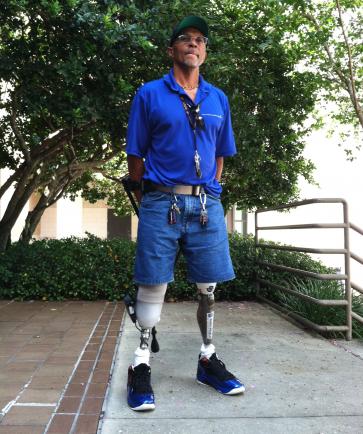
“A lot of people say, ‘Are you bitter you lost both your legs trying to be a contractor in Afghanistan?’ and I look at it from a different perspective,” Nicholson said. “That’s a small price I personally paid so that others don’t have to. I protected them, that’s priceless. You can’t put a dollar amount on the good that we did.”

His recovery as a double amputee and a private contractor is different than that of active duty military injured in Afghanistan. He has to rely on Workers Compensation for his prosthetics, crutches, wheelchair and things like a van.

Nicholson is up to the challenge with the aid of his two bionic legs.

“It took a lot of hard physical therapy,” Nicholson said, but it’s paying off. He’s at about 85 percent when walking on his computer-controlled bionic legs. He’s ridden a horse, but says the real test will be when he can dance.

Sunday, October 30, 2011

Hire a VETERAN

The news for Veterans in the job market is not good. This article simplifies the issue to a question of how VETS present their experience but it also comes down to companies not making a concerned effort to give VETS an interview as you can always learn more in person than by just scanning a resume. Our military VETS have served the country, and companies need to make an effort to give them a chance to land a job.

Veterans are mission driven and dependable. You will find that hiring a VET is one of the best moves any company can make.

Vet jobless rate 2.6 pct higher than general population
As wars wind down, lawmakers and groups focus on issue
By Roy Strom / Reuters


NAPERVILLE, Ill, Oct 29 (Reuters) - When Matthew Burrell left the U.S. Army after eight years of service, he landed a job as a public relations contractor in Iraq. With a salary of $170,000, he figured military experience had finally paid off.

But five months after returning home to Chicago, 33-year-old Burrell is unemployed and his search for a job in the private sector has left him disheartened.

Despite having six years of experience as a public relations officer in the Army, he said he is treated as though he had just graduated from college.

"I can tell you for a fact that definitely in my field in public relations and marketing, private-sector companies do not value (military experience)," Burrell said.

Burrell, along with many of what the Department of Labor says are 235,000 unemployed veterans from the Iraq and Afghanistan wars, has run into a vexing problem.

Many U.S. companies, and sometimes veterans themselves, do not know how to translate military experience into civilian skills. There is a disconnect between companies demanding a college degree and veterans giving confusing descriptions of their military experience to civilian employers.

That disconnect has contributed to veterans having an unemployment rate 2.6 percent higher than the general population, according to September's Bureau of Labor Statistics unemployment report.
As U.S. involvement in Iraq and Afghanistan winds down, lawmakers and organizations are starting to address the issue.

The Obama administration this week announced steps that include encouraging community health centers to hire 8,000 veterans over the next three years, and improving training opportunities for military medics to become physician assistants.

The U.S. Chamber of Commerce said it hopes to get 15,000 veterans hired through 100 job fairs around the country for veterans this year. One of those job fairs was held recently in Naperville, a Chicago suburb, giving 86 companies the chance to meet more than 600 veterans.

'TONE THAT DOWN'

One problem is that veterans need to explain more clearly to companies the value of their experience, said Kevin Schmiegel, vice president of veterans' employment programs at the Chamber of Commerce.

Hiring managers who have not served in the military are often bewildered by the jargon used by soldiers and weapons specialists, said Becky Brillon, who heads a program at the Community Career Center in Naperville.

A military job title might be listed like this: "25 Romeo visual and media equipment operator and maintainer."

"If somebody was artillery, or a sharpshooter or a sniper, you have to tone that down in the civilian world. It's more about being detail-oriented, precise and focused," she said.

On the flip side, private employers should give more credit to the experience and skills veterans acquire in the military, Schmiegel said.

Some military jobs, like a mechanic or technician, are fairly easily adapted to the private sector. But military credentials and certificates for other forms of training do not seem to carry much weight.

Rick Combs, a 27-year-old who retired as a sergeant in the Army, says he was given management training in the military. So far that training has not translated into a comparable private-sector job.

"You can come in, and slap something down that says, 'Here, the military says I can lead people. Give me a department and I will make it dance for you,'" Combs said. "I haven't had the opportunity on the civilian side yet."

Sunday, February 20, 2011

Massachusetts Governor plays politics with Veterans services office....turned it into a blatantly political operation to bolster his re-election....


This story should be no surprise to anyone who has observed the way that the liberal left has an absolute disdain for Veterans, especially the Democratic Party operatives. They have called us " War Mongers", " Baby Killers" and any other slur they can use to libel those who have worn the uniform and stood in defense of our country. This has been part of the Democratic DNA since the mid 60's when the party turned away from JFK's philosophy of a strong defense and went with the what the hippies and George McGovern spouted. Seems as they forgot that the only reason they were able to live free and spout off about the military was because Veterans paid for that right with their sacrifices and many times, with their lives.

Now, they have decided that the best way to use the Veterans is to take over the Veterans' services departments and turn it into another political machine to prop up the very people who show utter contempt for Veterans.

Case in point, Governor Deval " Spend-it-all" Patrick, who is Obama's best buddy fired the Massachusetts secretary of Veterans Services for four governors, Tom Kelly, Medal of Honor recipient and replaced him with his own political appointee.

Now, they are purging further into the staff and fired Tom Kelly's 2nd in charge while she was out on a medical leave. No reason for this change other than they can.

There will be a special place in Hell for these weasels when they have to answer for their sins. To take what is supposed to be a non-political program and use it as a prop to further your electability is beneath contempt. Deval Patrick and Obama never wore the uniform because they always saw service in the military as the kind of work that others had to do.....it was beneath them....But now when it is part of their political machine, they will be more than happy to try to "latch on" to the Veterans and tout how they have always admired them for their service.

Deval Patrick doesn't care for Veterans and neither does Obama. Veterans are political props for these two empty suits and the sooner we jettison these two fools back to where they came from, the better off we will be.


At Massachusetts Veterans Services, charges of playing politics
By Kevin Cullen
Globe Columnist / February 20, 2011

Maria Spiewakowski saw it coming.

“After Tom Kelley was fired,’’ she recalled, “I said, ‘I’m next.’ ’’

She was. Kelley, Massachusetts secretary of Veterans Services for four governors, was informed after Christmas that he was being replaced. The 71-year-old Kelley is a Medal of Honor recipient and his ousting was controversial, as much for the way it was handled as anything.

Spiewakowski worked in Veterans Services for 18 years, rising through the ranks to become Kelley’s No. 2. But when Coleman Nee was hired as undersecretary in 2007 on orders, Kelley says, from the governor’s office, she was suddenly No. 3.

Upset over the way Kelley was treated, and dealing with a medical problem of her own, Spiewakowski went on medical leave Jan. 18.

She got a Jan. 24 letter from Nee, Kelley’s replacement. “I know you’ve been away from work but I need to meet with you briefly to discuss my vision for Veterans Services,’’ Nee wrote.

Four days later there was another letter, saying she was fired.

“Incoming leadership has the authority to select its management team to carry out its policy goals,’’ Nee wrote. “This often necessitates the replacement of existing personnel. As a result, this action should not be construed in any way as a reflection on you personally or on your performance under prior leadership.’’

Spiewakowski’s removal was similar to Kelley’s. Kelley was asked by his boss, Health and Human Services Secretary JudyAnn Bigby, to show up for a meeting to talk about the department’s future.

When Kelley got there, the only thing about the future that was discussed was his not being part of it.

Governor Deval Patrick had every right to replace Kelley, just as Coleman Nee has the authority to replace Spiewakowski. The problem for both the governor and his new veterans secretary is that the people being replaced are not going softly into the night.

Spiewakowski and Kelley are saying publicly what had been whispered: that Nee turned the department that oversees the welfare of the state’s 400,000 veterans into a blatantly political operation to burnish the images of Patrick and Lieutenant Governor Tim Murray.

Spiewakowski says employees were asked to volunteer for campaign efforts, and that Nee and some workers busied themselves with efforts to reelect the governor on department time.

Nee denies each and every one of the allegations.

Asked about firing someone on medical leave, he said he “can’t talk about personnel issues.’’ As for why Spiewakowski was fired, he said, “We’ve had some restructuring, some positions consolidated.’’

Asked if there is an ongoing purge of anyone perceived as a Kelley loyalist, Nee said, “That’s nonsense. I haven’t given any litmus test.’’

Spiewakowski says Nee put a political gloss on things that had been previously apolitical. For example, she said the department’s newsletter became a vehicle to emphasize the Patrick administration’s commitment to veterans as much as a way to inform veterans about services.

Kelley agrees, saying, “The newsletter had not been used like that before.’’

Nee scoffs at this. He said complaints that the newsletter was politicized are really bruised feelings about his efforts to modernize the department.

“Everything down here was using an old dynamic,’’ he said.

Spiewakowski and Kelley say Nee intervened when a contract employee was about to be fired for poor performance. They declare that Nee said Murray and the governor’s office wanted the employee kept on.

“That’s an absolute lie,’’ Nee said.

But Spiewakowski and Kelley say that episode hurt morale and made it clear that some workers had inside pull with the administration and would be treated differently.

Kelley says that in June 2009, Nee told him his main priority was to get the Patrick-Murray team reelected and to get veterans behind the effort. Kelley was so disturbed that he immediately wrote a memo about it.

“I never said that,’’ Nee told me.

Spiewakowski and Kelley say one employee complained that Nee had approached him in the workplace and asked him about lining up veterans to support the governor’s reelection campaign.

Nee said he didn’t recall approaching employees. Asked if doing so would be an ethical violation, Nee said, “I think it would. But I don’t think I’d do that.’’

Spiewakowski said she was going public because the department’s morale has been destroyed.

“I can respect the governor and lieutenant governor making the decision to replace Tom,’’ she said. “I can’t accept that Coleman Nee is the person to replace Tom, because he has completely politicized the office and its work.’’

Spiewakowski is not alone. Several others who worked or still work for Veterans Services have filed complaints against Nee with the Ethics Commission and the Office of Campaign and Political Finance.

Nee’s first battle in his new job is against an insurgency within his own staff.

He acknowledged he has heard from ethics and finance investigators, looking for records. But he is confident he did nothing wrong. “Anybody can make a complaint to OCPF or Ethics,’’ he said.

I asked Nee why some people are trying to destroy him.

“I don’t know what the motivations are, and frankly I don’t want to speculate,’’ he said. “But it’s always anonymous. If they are veterans and saying this, then they are heroes, and they should have some guts and come out of the shadows and say it to me. Say it to my face.’’

If the department of Veterans Services wasn’t politicized before, it sure is now.

Kevin Cullen is a Globe columnist. He can be reached at cullen@globe.com

Wednesday, December 8, 2010

Patriot Paws and Hounds4Heroes / Two Great organizations that provide K-9s for our Vets with PTSD


As a fan of our K-9 companions, this kind of story is the stuff that we need more of to help those who need it....Dogs are instinctive caring and completely devoted to their owners....this is what works best and the cost is more cost effective than almost anything else we can provide.....

Bringing Dogs to Heal - K-9s Help out Vets with PTSD

By MARK THOMPSON - Time Magazine

Staff sergeant Brad Fasnacht was clearing mines on an Afghan road a year ago when an IED blast broke his spine and both ankles and put him in a two-week stupor that ended only when he woke up, 7,000 miles away, at Walter Reed Army Medical Center in Washington. The explosion had knocked his helmeted head so violently, he suffered a traumatic brain injury, which exacerbates his posttraumatic stress disorder (PTSD). Although Army doctors and nurses have been able to get the 26-year-old walking again, he has had to call in a specialist - Sapper, an Australian cattle dog mix - to help tackle his PTSD. (See a video of dogs helping veterans cope with PTSD.)

"He has changed my life," Fasnacht says of the 1-year-old mutt, whose name is shorthand for "combat engineer," Fasnacht's Army job. Sapper goes with him whenever he leaves his Silver Spring, Md., apartment, something he was terrified of doing until he got his canine companion in April. Three combat tours and two Purple Hearts had left him in a state of hypervigilance, constantly scanning suburban streets and trees for snipers. War had made him wary of crowds - and even of individuals who got a little too close. "I'd just freak out, getting really uneasy," he says. "But not anymore." The speckled dog calms Fasnacht's anxieties and keeps them from mushrooming into panic attacks. Part bodyguard, part therapist, Sapper also serves as an extra set of eyes and ears. "I've lost some of my hearing, but Sapper alerts me if someone is coming up behind me," he says. When Fasnacht is sleeping, the dog will wake him from a nightmare by licking his face.

As researchers test high-tech PTSD treatments (such as hyperbaric oxygen chambers and virtual-reality exposure therapy), a low-tech alternative is emerging in the form of man's best friend. Although the government has been providing service dogs to troops who have lost their sight or suffered other physical injuries, it is only beginning to look into whether these animals can improve the lives of those who are psychically injured. The need for good treatment options is enormous: some 40,000 troops have been physically wounded in Afghanistan and Iraq, but 10 times as many exhibit symptoms of PTSD.

(Amid all this hard-to-heal pain, veterans and dog-training organizations, some with playful names like Patriot Paws and Hounds4Heroes, are rushing to pair wounded vets with trained canines. One of the leaders of this movement, Dave Sharpe, 31, was so traumatized during deployments to Saudi Arabia and Uzbekistan that his anxiety and recurring nightmares kept him largely confined to his Yorktown, Va., home. "I was always looking for a fight," he says. "I was beating on the walls." But he says all that changed when a friend encouraged him in 2002 to visit an animal-rescue shelter, where he spied 2-month-old Cheyenne. Not long after he adopted the brown and white pit bull mix, Sharpe had another dream about the Taliban sympathizer who pulled a gun on him. When Sharpe woke up in a cold sweat, the dog was watching him. "What are you looking at?" he recalls yelling. Cheyenne barked in response, and after he told her to shut up, she barked again, prompting him to wrap her in his arms, collapse on his bed and tell her everything that was weighing on his mind. "I just lost it," he says. "I have no idea why, but I felt completely at ease."

Sharpe credits the dog for such a dramatic improvement in his PTSD that he went on to found the nonprofit P2V - short for Pets2Vets - last year. Since then, he has been sharing his story with soldiers, cops, firefighters, first responders - people who could use their own Cheyenne - and has given dogs to Fasnacht and some 20 other vets. His promise to servicemen and -women in need: "We'll get you your pet within a month, maximum."

Not everyone is convinced such quick pairings are a good idea. For starters, it's still an open question whether dogs actually help alleviate PTSD. Both the VA and the Army are launching studies designed to confirm widespread anecdotal evidence that the benefits are real. And if they are, the next big question is whether shelter dogs like Sapper, who took two weeks and $350 to train, provide as much relief as specially trained dogs, which take two years - and up to $35,000 - before they are ready to be paired with a wounded vet. "I really believe the dogs can provide tremendous benefits," says Minnesota Senator Al Franken, who authored a law ordering the VA to study dogs' effects on PTSD sufferers. "The whole point of this is to measure in a scientifically valid way what the benefits are of service dogs to vets with psychological injuries and make a better life for these guys and women who have put everything on the line for us."

Better than Music and Art

Mental-health experts have been looking into canine-centric therapies for years. Sandra Barker, a psychiatry professor at Virginia Commonwealth University (and yes, she is used to all the jokes about her last name), published a study in 1998 that found psychiatric patients' anxiety dropped twice as much after spending 30 minutes with dogs as it did following standard therapeutic recreation involving music and art. A 2003 Barker study reported a "significant reduction" in fear among patients awaiting electroconvulsive therapy after spending only 15 minutes with dogs. And in March she published a study detailing the "buffering effect" dogs have on the stress experienced by their human partners, as measured through cortisol levels, heart rate and blood pressure.

Given her findings, it's not surprising that Walter Reed and other military medical centers have started stationing dogs on hospital floors to help calm patients. "The potential for animals to be another form of alternative medicine is enormous," says Elspeth Ritchie, a former Army colonel who just retired as one of the service's top psychiatrists.(See a TIME photographer's Iraq diary.)

With a push from Franken, the VA is planning to place dogs - for which it will pay $10,000 apiece - with up to 200 vets suffering from mental and physical ailments. The Army is considering a similar program. But both plan to use only service dogs trained by groups belonging to Assistance Dogs International (ADI), which represents 73 U.S. dog-training organizations. That's because such a designation gives dogs access to airports, hotels and other public spaces that don't allow common pets. "In a restaurant, you don't want a dog groveling around for a dropped french fry or urinating on the carpet," says Corey Hudson, president of ADI's North American branch and head of Canine Companions for Independence in Santa Rosa, Calif. "That requires two years of training."

Sebastian "Sam" Cila was lucky enough to be given one of the 2,000 or so service dogs that are trained annually in the U.S. The retired Army National Guard sergeant from Riverhead, N.Y., had been through hell since July 4, 2005, when an IED in Iraq shredded much of his left arm. Three years and more than 40 surgeries later, he had to have his left hand amputated. "The loss of my hand put me into a tailspin, and I fell into a deep depression," says Cila, 37. When Gillian, a black Labrador arrived in February, she knew how to do things like open doors and turn off lights. But like some other service dogs trained to detect the onset of seizures, Gillian can alert him to the little things that can trigger panic attacks or angry outbursts that can be tough to control - and help him avoid them. "Now when I feel stressed, irritable or anxious, she definitely relieves all those symptoms," Cila says of his PTSD. "I definitely still have it, but I've learned, with the help of Gillian, how to deal with it better."

But certified service dogs like Gillian don't come equipped with more PTSD-specific commands than cheaper mutts do. "Your average service dog coming out of these agencies can do 82 different tasks. But if you've got a veteran whose main problem is PTSD, what does turning on a light switch do for him?" asks Jim Stanek, 30, who ended three tours in Iraq with PTSD and now runs Paws and Stripes in Albuquerque, N.M., pairing dogs with mentally ailing vets. (See pictures of the U.S. Army Reserve.)

PTSD-Specific Tasks

Stanek trains his dogs to perform 10 or so PTSD-specific tasks. Some of them are designed to ease concerns about blind spots, not unlike the way a military unit designates someone to watch troops' backs or to scout ahead. Stanek's 2-year-old Catahoula mix, Sarge, for example, has been trained to check around the corner to see what's in the next aisle at a store.

Efforts by Stanek - whose group is willing to train a family pet if it meets age, size and temperament requirements - and others advocating cheaply trained dogs just got a boost from the Justice Department. In September it tweaked regulations clarifying parts of 1990's Americans with Disabilities Act. The amendments limit the definition of service animals to dogs. (Sorry, pigs and parrots - although the agency left the door open to miniature horses, in part because they live a lot longer than dogs.) To qualify as a service animal, dogs must be trained to do work or perform tasks like "providing safety checks and room searches for persons with PTSD," the agency noted. But the dogs do not have to be formally trained by an ADI-approved school. Such a requirement "might limit access to service animals for individuals with limited financial resources," the department said.

The new regulations take effect March 15. And perhaps the sight of seemingly healthy men and women with seemingly run-of-the-mill mutts on planes or college campuses or in restaurants or places of worship will lead to more conversations about PTSD. "People ask about the dog, and it's kind of forced me to talk to them, which is something I didn't want to do," says Stanek. "A comfort comes from having a second set of eyes that doesn't judge."
Serviceman's Best Friend

See how canine companions assist psychically injured soldiers and veterans, at time.com/dogs_of_war

This article originally appeared in the November 22, 2010 issue of TIME Magazine.